
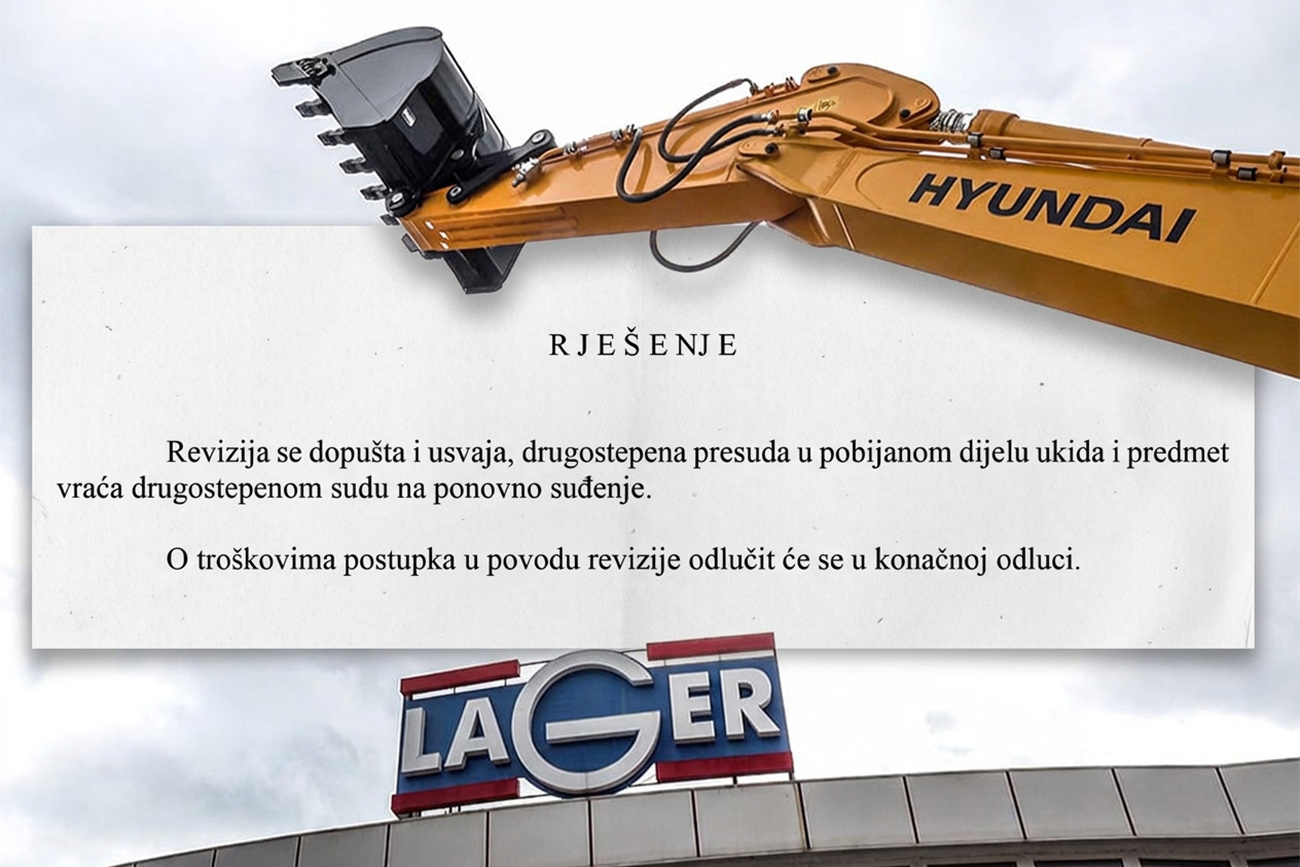
The Supreme Court of the Federation of Bosnia and Herzegovina (FBiH) has upheld a revision appeal lodged by the Centre for Investigative Reporting (CIN), overturning a ruling by the Cantonal Court in Široki Brijeg which had found CIN’s investigative reports on the Posušje-based company Lager to be defamatory.
The case has been referred back to the Cantonal Court for a retrial.
In 2025, the Cantonal Court upheld a ruling by the Municipal Court in Široki Brijeg, finding, among other things, that CIN had failed to prove that public institutions had favoured Lager when awarding it concessions to extract stone and coal, despite the company’s failure to meet the relevant requirements and fulfil its prior obligations. The court also ruled that altering a product catalogue during a public procurement procedure did not amount to an “attempt to deceive”, since other bidders had done the same.
The court further concluded that CIN had relied on information from non-final court rulings in its investigation and had thereby damaged Lager’s reputation through defamation. It ordered CIN to remove the articles Stockpiling Concessions and Lager’s Faulty Goods, publish an extract from the ruling in the same location, and pay BAM 1,000 in damages.
Questioning the soundness of the Cantonal Court’s conclusions, CIN asked the Supreme Court of the Federation of Bosnia and Herzegovina to grant leave to appeal on points of law and determine whether it was acceptable to penalise journalists for reporting on ongoing public court proceedings without first establishing whether the reporting was in the public interest, whether it had prejudiced the proceedings, and whether such a ruling effectively imposed a ban on reporting from the courts.
The Supreme Court of the FBiH concluded that the second-instance court failed to apply the constitutional and Convention standards for establishing defamation. It explained that, in defamation cases, courts must first determine whether the right to freedom of expression has been infringed and then assess whether the circumstances justified that interference. The ruling states that the courts failed to carry out such an assessment in this case.
In 2021, CIN investigated the business activities of the Posušje-based company owned by Milenko Bašić. It published reports on how concessions to extract coal in Sanski Most had been awarded, as well as on the sale of construction machinery which Lager marketed to customers as new, despite supplying machines that had been modified or assembled from older parts.
The Supreme Court found that these were matters of public interest that warranted reporting. Any question of defamation liability, it said, had to be assessed in the context of the entire article and the specific social context in which it was published. In assessing the evidence, however, the Cantonal Court had failed to take into account the particular nature of journalistic work.
The European Court’s case law allows the media to defend themselves if they can demonstrate that they acted reasonably or in accordance with professional standards – in other words, that they acted in ‘good faith’ when publishing critical statements.
The Supreme Court also points out that the European Convention on Human Rights guarantees press freedom to inform the public, as well as the public’s right to receive information. This includes the right to information about ongoing court proceedings. It further stresses that any decision ordering the removal of articles must be supported by clear reasoning – something missing from the ruling in this case:
(…) removing a news article requires a convincing assessment of proportionality and whether such a measure is necessary in a democratic society. Less restrictive measures must also be considered. The failure to provide reasons on these points constitutes a departure from the standards established in the European Court’s case law.
CIN’s articles will be reinstated on its website as soon as possible, in accordance with the required procedure.
The Supreme Court of the FBiH also ruled that the fact that the administrative and court proceedings covered by the journalists’ reports had not yet been finally concluded did not deprive the public of its right to information.
It is unacceptable to expect the defendants, in the course of their journalistic work, to assume the burden of proof in the same manner and to the same extent as would be required in court proceedings, the ruling states.
In the retrial, the Cantonal Court in Široki Brijeg will have to take into account all the factors highlighted by the Supreme Court of the FBiH when assessing whether the articles constituted defamation.
This will be the fifth ruling in the ordinary court proceedings arising from Lager’s lawsuit against CIN, its editor-in-chief and the author of the articles published in June 2021.
In its lawsuit, Lager claimed that the publication of the articles had damaged the company’s reputation, alleging that they contained falsehoods and information that was incomplete and presented in a tendentious manner, creating a misleading impression among the wider public about the way the company conducted its business.
In December 2023, the Municipal Court in Široki Brijeg issued a first-instance ruling in Lager’s favour. In her judgment, the presiding judge, Radmila Mandić, copied passages from a ruling issued by her colleague, Snježana Parlain, in a case Lager had brought against another media outlet. Mandić was subsequently disciplined over this.
Following an appeal, the Lager v. CIN case was sent back to the Municipal Court in Široki Brijeg, where it was assigned to Judge Parlain. In May 2025, she too ruled that the articles were defamatory and ordered their removal from CIN’s website. Her ruling was upheld by the Cantonal Court in Široki Brijeg in November 2025.
CIN filed a request for review against the ruling in January 2026, but Judge Parlain did not forward it to the Supreme Court of the FBiH for consideration until eight months later.