

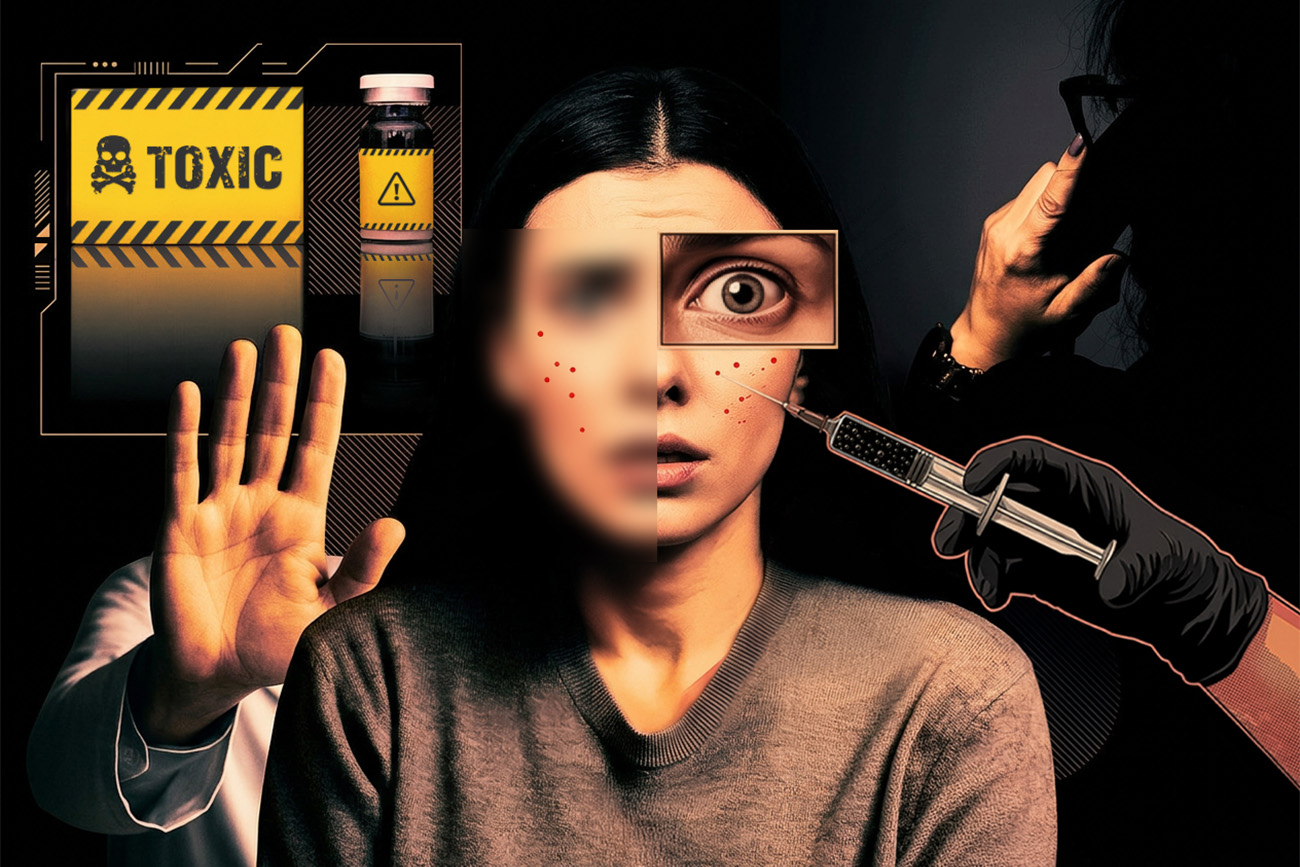
In the indictment against Dr. Aida Salčinović, the Zenica Cantonal Prosecutor’s Office describes the alleged offence as follows: “She injected dermal fillers into a patient (…) in a space that was not clean (…)”.
The patient described the 2021 incident in greater detail to CIN reporters: “We agreed to meet in the car park in front of a shopping centre (in Visoko, A.N.) and at her suggestion it happened inside that shopping centre – in a public toilet (…) it’s a very narrow, tiny space where two people can barely fit.”
Shortly afterwards, the woman’s face began to deform as painful bruising spread across her skin, while debilitating headaches became a daily ordeal.
The alleged act, one that appears to fly in the face of basic medical standards, has, since autumn 2025, been the subject of an indictment charging Dr. Salčinović, now the serving Health Minister of Zenica-Doboj Canton, with causing grievous bodily harm to a 47-year-old patient from Visoko, identified as I.B. At her first court hearing, she pleaded not guilty.
CIN reporters also found that, at the time, Salčinović was an emergency medicine specialist without the additional training required to perform such aesthetic procedures. The prosecution did not explain to reporters why this was not included in the indictment.
I.B. described the incident as “the worst experience of my life” when speaking to CIN in August 2025. By then, she had already filed a criminal complaint against Dr. Salčinović, but chose not to speak publicly at the time in order not to jeopardise the legal proceedings.
Treatment in a Visoko Shopping Centre
“Every woman wants to freshen up a bit, and so did I,” I.B. told a CIN reporter, almost apologetically, anticipating criticism from others.
She says she first met Aida Salčinović in a cosmetic salon in Sarajevo in 2020. “There were lots of women there. Everyone was waiting for her treatments with Botox and hyaluronic acid. That’s how I heard about her,” I.B. begins.
Their conversation about beauty led to an appointment for cheek fillers – injections of hyaluronic acid gel used to fill wrinkles and improve facial contours.
Their first planned meeting in Sarajevo never took place, so they agreed to “meet halfway” in Visoko. In June 2021, in the toilet of a local shopping centre, Dr. Salčinović injected dermal filler into I.B.’s face and took 700 marks in cash without issuing a receipt, the patient claims.
“At no point did she show me what she was injecting, give me any product code, or ask me to sign any consent form (…) I never imagined something could go wrong.”
Under the Regulations governing the conditions for space, equipment, and personnel for the establishment and performance of healthcare activities in healthcare institutions, such procedures must be performed in a registered medical practice by specialists in plastic, aesthetic, and reconstructive surgery, maxillofacial surgery, ophthalmology, or dermatovenerology. Since January 2026, minor procedures have also been permitted in dental practices. The premises must meet hygiene standards and be properly equipped. Patients should also receive full information about the procedure beforehand.
Dr. Musfaha Burgić, owner of the Centre for Aesthetic Medicine and Aesthetic Surgery in Tuzla, says patients must receive documentation detailing the procedure and the product used. Patients should also be informed of everything in advance, and before any intervention, they should sign a consent form outlining possible complications.
None of this happened in Visoko, says I.B.
Botulinum toxin type A is a drug and a neurotoxin that temporarily blocks nerve impulses to muscles, causing them to relax and reducing the appearance of wrinkles. It is also used to treat migraines, strabismus, muscle spasms, and excessive sweating.
Unlike Botox, fillers are not drugs but medical devices. Most are based on hyaluronic acid, which binds water and restores volume and elasticity to the skin. Fillers are used to fill deep wrinkles, enhance lips, and shape facial contours. They work mechanically, filling the space beneath the skin without affecting muscles or nerve endings.
Soon after the procedure, I.B. began feeling pain on the left side of her face. “I called her. She (Dr. Salčinović, A.N.) said: ‘That’s OK, that’s a completely normal reaction at the beginning.’”
But nothing felt normal. Her face became inflamed and swollen, wounds appeared on her cheeks, and she began experiencing vision problems and severe headaches.
“These aren’t ordinary headaches. I can’t even describe them. You feel like you’re falling apart, you can’t see properly, your eyes are blurred… ” It’s awful,” she said, recalling how she sent photos and videos to the doctor asking for help. Her condition continued to worsen, so a year after the procedure, Salčinović suggested blood plasma therapy. I.B. agreed. “By then, I was desperate. It had been going on for so long, and it was affecting every part of my life, my work, everything.”
At the time, I.B. says, she did not know that Dr. Salčinović lacked the specialist qualifications and authorisation to perform such treatments. Salčinović graduated from the Sarajevo University Faculty of Medicine in 2010 and began working at the Zenica Cantonal Hospital the same year. She completed a specialisation in emergency medicine in 2015, which does not permit aesthetic medicine procedures under existing regulations.
Only in 2025, four years after the disputed treatment, did she begin specialising in dermatovenerology at Zenica Cantonal Hospital, the Federation of Bosnia and Herzegovina’s Ministry of Health confirmed to CIN.
“At the time, I was inclined to trust her (…) We tend to see people in white coats differently,” says I.B.
A Struggle to Return to Normal Life
In blood plasma therapy, doctors extract cells and proteins from a patient’s venous blood and reinject them to stimulate the regeneration of skin and underlying tissue, according to the explanation on the website of the Sarajevo Center for Aesthetic Surgery “Naša mala klinika”.
Dr. Salčinović performed the first such treatment in mid-2022 in a hair and beauty salon in Austria, says I.B. However, the salon’s co-owner, Edin Bešić, told CIN that although he has known Salčinović for years, such treatments are not carried out at his salon, and the patient’s claims are untrue.
The second treatment took place in Zenica in premises resembling a beauty salon. “There was no sign, the windows were tinted or covered with paper or foil (…), and it was locked,” I.B. said.
When that treatment also failed, she sought a second medical opinion. Dr. Salčinović took her to see a colleague at the hospital. The following day, enzyme therapy was administered at Zenica Cantonal Hospital. I.B. says she filled out no medical documentation and that the procedure was not recorded in the hospital’s official logs.
Hospital director Dr. Tarik Zulović said in a written response to CIN that the institution could find no record of the incident in its official documentation and that surveillance footage had meanwhile been deleted in accordance with data retention rules.
A few days later, in October 2022, the two met again in the same unnamed salon. Dr. Salčinović arrived with a man and told her she had no time because clients were waiting in Sarajevo. “That was the last time we saw each other,” I.B. recalls.
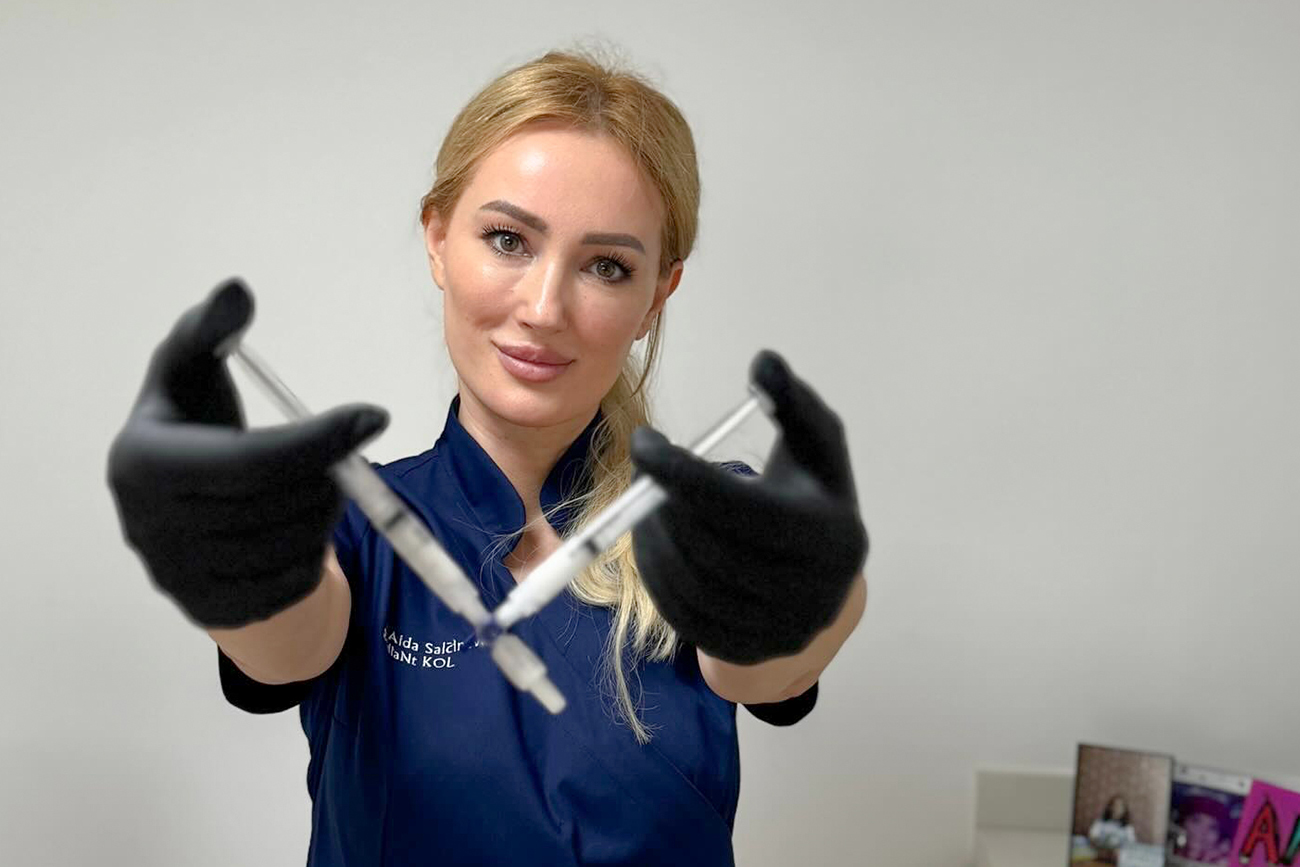
I.B. says that by then she realised she had been left to fend for herself. Since 2023, she has sought treatment across several countries, from France to Germany, where she spent a month in hospital, and back to Bosnia and Herzegovina. Instead of dissolving, the filler remained trapped in her tissue, while symptoms of severe infection in the meantime spread to the other side of her face.
“There were days when I couldn’t get out of bed. I couldn’t walk. I was broken.”
Dr. Sanela Salihagić, professor at the University of Sarajevo’s Faculty of Medicine and head of the Clinic for Reconstructive and Plastic Surgery, told CIN that complications can arise after hyaluronic filler and Botox treatments just as they can after any medical procedure. These can range from infection and tissue necrosis to septic conditions and muscle paralysis.
Specialists interviewed by CIN said dealing with complications is particularly difficult and challenging when patients have undergone procedures performed by other doctors or by individuals without proper training.
“I’m always happy to help anyone, and advise them on what to do, but the person who caused the complications should be the one dealing with them,” said plastic and reconstructive surgeon Dr. Alemko Čvorak of Naša mala klinika.
I.B. says she reported her case to the Agency for Medicinal Products and Medical Devices of Bosnia and Herzegovina and to the Zenica-Doboj Cantonal inspectorate in late 2022 and early 2023, as well as to Zenica Cantonal Hospital. She claims the Agency told her it could not act because she did not possess the original filler product code, which the doctor should have provided during the initial treatment. Inspectors told her they could not locate the premises where the meetings with the doctor had taken place. In response to CIN, however, the inspectorate said only that several inspections had been conducted following the complaint.
CIN repeatedly invited Aida Salčinović to comment on the allegations, but she declined while court proceedings are ongoing.
Nine months before the indictment was filed, however, she responded to an inquiry sent by CIN to the Zenica-Doboj Cantonal Anti-Corruption Office about her activities outside the ministry. She said she volunteered as part of the San Tech Medik company team, providing educational activities.
For years, the company showcased aesthetic procedures performed by Dr. Salčinović on its clients on social media, and in 2019 promoted her as a visiting practitioner offering beauty treatments in Austria. Salčinović herself also regularly posted aesthetic procedures she performed on social media.
In the summer of 2023, I.B. ultimately turned to the Zenica-Doboj Cantonal Prosecutor’s Office, which filed an indictment against Dr. Salčinović in late 2025. The trial began at the Municipal Court in Visoko, where she pleaded not guilty to causing grievous bodily harm to I.B.
“As for any personal satisfaction or justice, I will never get it (…) my health has been irreversibly destroyed. Today, I am a sick person, I am disabled (…) I am unable to work or earn a living to have a normal life,” says I.B.