
Between early 2020 and the end of 2025, Lukavac’s municipal authorities sold nearly 5,000 square metres of public land through direct agreements for a total of 485,736 BAM. These transactions relied on a legal exception that allowed private landowners to purchase small adjoining plots of public land to make their holdings viable for development.
In four out of nine cases, the land had already been mapped for residential-commercial construction and was sold to local entrepreneurs at a fraction of its market value.
By reselling municipal land, one of them made 257,000 BAM more than the City of Lukavac received from the direct sale of all nine plots combined.
One such case involves 478 square metres of municipal land sold in November 2023 to the family of Lukavac businessman Haris Al Amili for 81,000 BAM. Within the same month, the family resold the newly acquired land together with previously purchased plots, making a profit of 743,137 BAM on the portion that had belonged to the city.
The court-appointed expert who assessed the land’s value said he had not been aware that the regulatory plan foreseen a residential building on the site, a factor that would typically drive up the price.
Under the law, state-owned land should be sold through public tender. Direct agreements are permitted only in exceptional circumstances, such as for military, diplomatic, infrastructure, or religious projects, or for adjusting the boundaries of an existing building plot.
Lukavac authorities invoked the latter provision to sell land directly to the Al Amili family, as well as to firms Sultan from Poljice near Lukavac, Zaharex from Špionica Donja near Srebrenik, and 4K & Royal from Lukavac, the latter despite owning no adjacent property to adjust.
“Not everything foreseen in a regulatory plan should be resolved through direct deals and parcel adjustments … No, no, no. Many of these plots could and should have gone through standard procedures”, said Ismet Velić, a lawyer, academic, and former state attorney.
Deals Behind Closed Doors
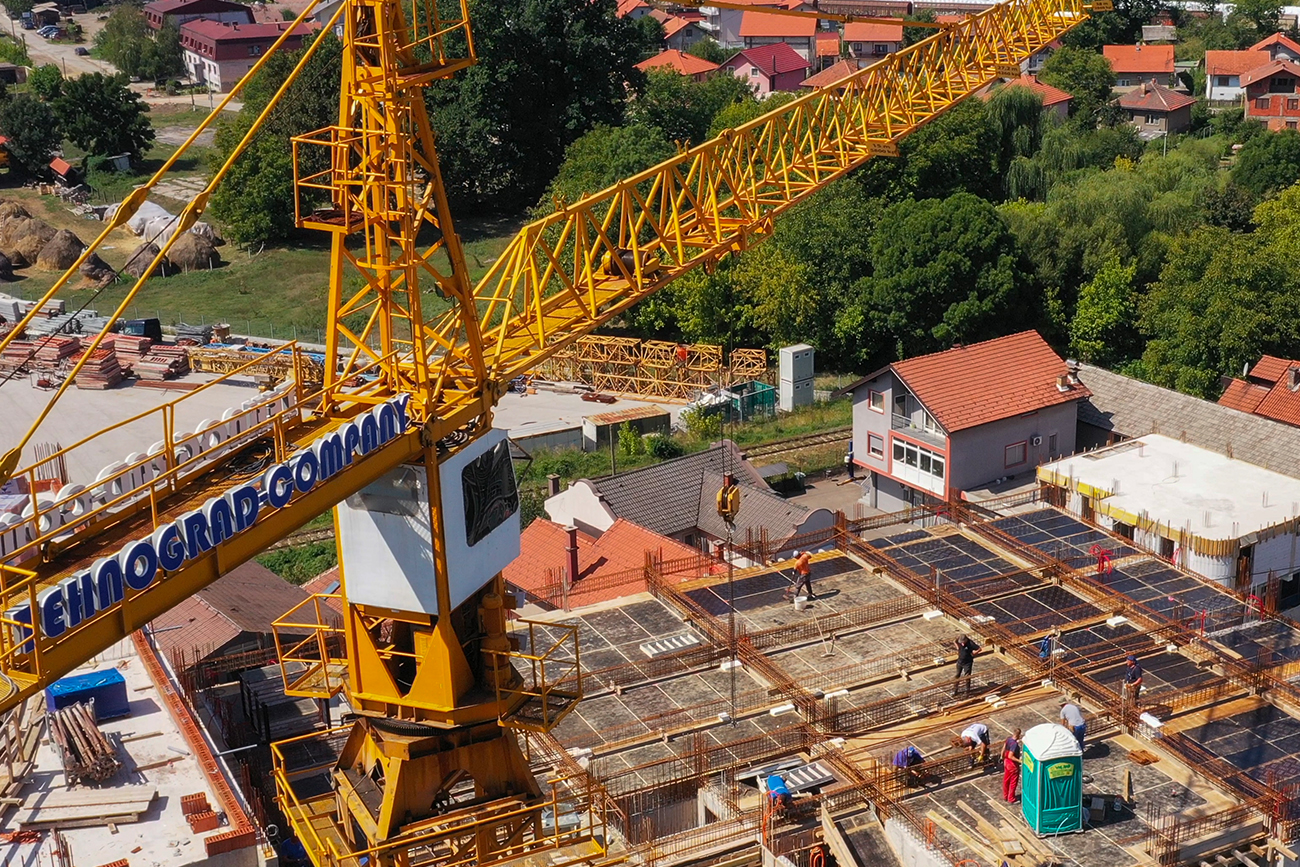
Tuzla-based construction firm Tehnograd Company began work in 2024 on a modern eight-storey residential building with underground parking in central Lukavac, near the local health centre.
The development is being built on a 1,271-square-metre plot that pensioner Amina Buzaljko sold to the company a year earlier for 2.19 million BAM. She was the widow of the late Lukavac doctor Fethi Al Amili and the nominal owner of the land, though the sale was handled by her son, Haris Al Amili.
The land had originally belonged to the City of Lukavac before being purchased by the Al Amili family. They later resold it to the Tehnograd Company at a significantly higher price.
The first plot measuring 793 square metres was acquired back in 1998, when the Al Amili family firm “Fethi lijek” purchased it directly from the Municipality of Lukavac for 166,530 German marks.
About two decades later, a major drainage infrastructure project was underway in Lukavac. A pipeline was planned to cross this private land, and the family agreed, but in return sought a portion of nearby municipal land.
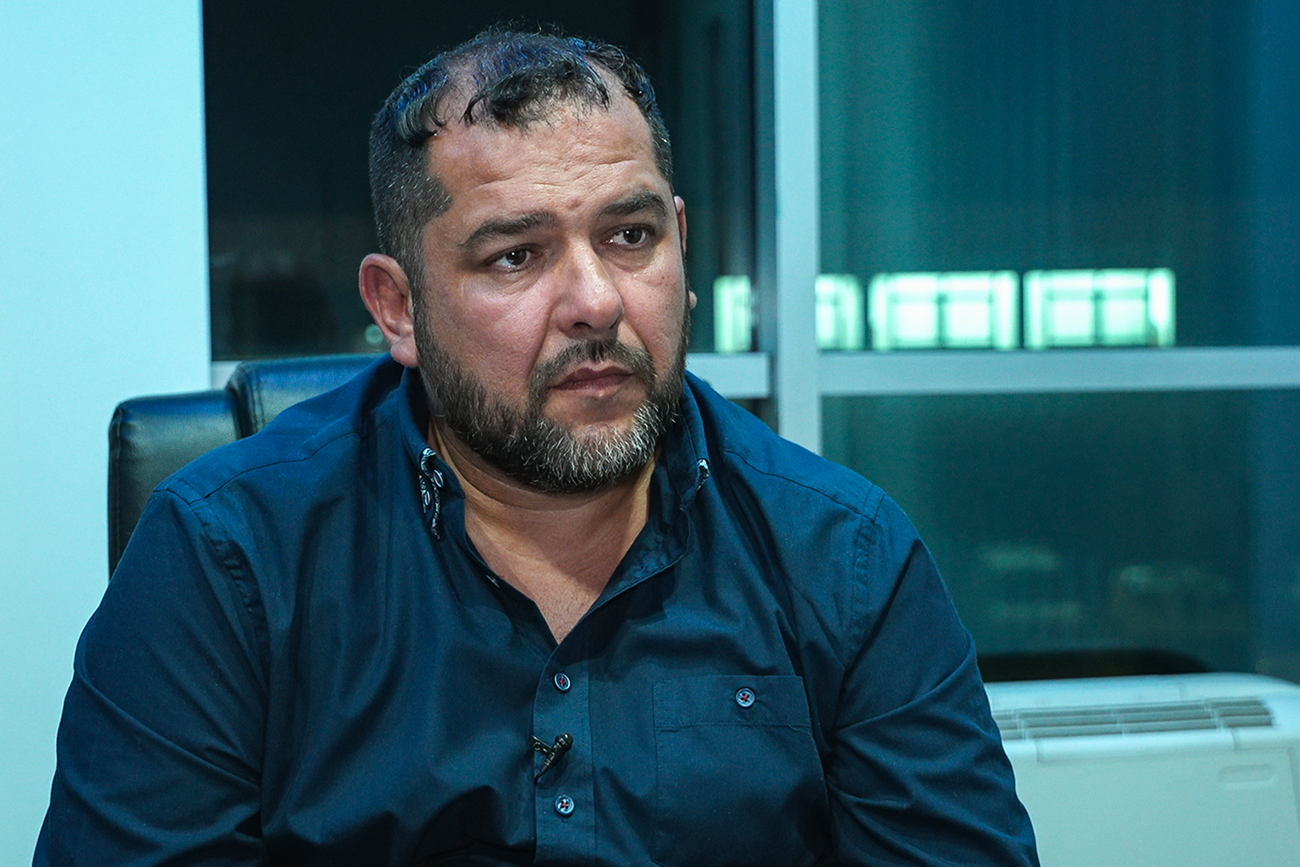
“We only realised it wasn’t municipal land when we brought the machinery to the site. That created a bit of a problem. (…) That was the first time we had ever met,” recalled Lukavac mayor Edin Delić.
The problem was ultimately resolved by granting the Al Amili family a 73-square-metre plot located roughly 20 metres from their existing land.
The arrangement was later detailed before the Tuzla Canton Prosecutor’s Office by Lukavac’s deputy municipal attorney, Rijad Biković, who gave a statement after reporting to police that Al Amili had allegedly threatened him and his family.
According to prosecutorial records, Biković said he had refused to process the case in the manner suggested – via intermediaries – by Mayor Edin Delić, which he interpreted as favouring Al Amili. He claimed the case was subsequently reassigned to a colleague.
Asked by reporters whether he had ever contacted Biković regarding the matter, Delić said he could not recall.
“Do you know when I contact the legal office or a municipal attorney? When something takes too long,” he said. “Sometimes we could be waiting two or three weeks… And I always say this: if something isn’t lawful, you must explain why. You can’t simply say it can’t be done. You have to justify it”, said Delić.
However, municipal attorney Jasminka Smajlović, who at the time was Biković’s superior, told CIN that he had not been involved in the case concerning the allocation of substitute land.
Lawyer Ismet Velić said it is not standard practice to allocate small, detached plots as compensation, particularly when they are not contiguous with the original parcel. In such cases, he argued, it would be more logical for the municipality to provide financial compensation from the city budget instead.
Between the newly allocated plot and the parcel the Al Amili family had purchased in 1998 lay a further 478 square metres of municipal land. With the approval of the city authorities, they went on to acquire this plot as well.
The Sarajevo-based IPSA Institute was commissioned to draft the regulatory plan. In late 2020, the Planning Council within the City Administration, chaired by Mayor Edin Delić, issued the following recommendation: “Near the Health Centre (…) provision should be made for the construction of a larger-scale multi-storey residential and commercial building.” That proposal was subsequently incorporated into the plan.
“He (Al Amili, reporter’s note) expressed an interest at the time in developing that land. When we were drawing up the regulatory plan, a building was mapped onto those plots in a way that aligned with the urban layout of the Health Centre, the road, and so on”, Delić told CIN.
With the approval of the municipal attorney’s office and by decision of the City Council, the authorities sold the parcel through a direct agreement, citing the “adjustment of a building plot” provision under the Federation of Bosnia and Herzegovina’s Law on Property Rights.
Ahead of the sale, the city appointed court-certified construction expert Jakub Pištoljević to assess the land’s value. He estimated the 478-square-metre plot at 81,413 BAM, the price paid by Amina Buzaljko in November 2023.
Pištoljević told CIN he had not been aware, at the time of the valuation, that a residential building had already been included in the zoning plan. According to Sarajevo-based construction expert Krešimir Filipović, that factor would have significantly increased the land’s value.
Less than a month later, after consolidating the plot through the additional purchase, Haris Al Amili resold the land to Tehnograd Company at a price roughly ten times higher than what he had paid the City of Lukavac.
“If a company from Tuzla paid a man in Lukavac 800,000 BAM, and he paid the tax and registered the property, then that money has effectively come back into Lukavac,” said Mayor Edin Delić.
“When the regulatory plan was adopted, I had several offers, and I chose Tehnograd. I gave them the project to build there. (…) I had higher offers from other construction firms”, explained Haris Al Amili.
Flats in the development are already on the market. According to a listing from March this year, prices are around 3,300 BAM per square metre.
Commercial premises are planned on the ground floor and have been purchased by Al Amili himself.
“I bought the commercial space in a shell condition, completely bare, without any fittings,” he said. “That was the agreement. I insisted on retaining the commercial unit,” said Haris Al Amili, declining to disclose how much he had paid.
A larger plot than the original
The noise of construction machinery shattered the calm of a quiet Lukavac neighbourhood in February 2025, at the junction of Armija BiH and Titova streets, near the Esmeralda building. Residents protested after workers began digging up the ground and cutting down trees lining the street.
The protest was led by lawyer and former judge Nisad Omerović, whose balcony view would be blocked if the new development goes ahead.
Seeking answers, locals discovered that a year earlier, the Department for Urban Planning, Property and Geodetic Affairs had granted planning consent to the Poljice-based firm Sultan to construct a building with commercial premises on part of a parking area and adjacent green space in their neighbourhood.
The process dates back to 2020, when the City Council unanimously adopted the regulatory plan. The Planning Council, chaired by Mayor Edin Delić, proposed “the construction of a multi-storey residential and commercial building in place of the planned parking spaces”.
On that site, the Sultanić family-owned company Sultan had purchased 250 square metres of land from the Municipality of Lukavac back in 1999, with the intention of building a small commercial unit with a ground floor and one additional storey. The project was never realised.
Citing the need to “adjust” the building plot, the company acquired a further 257 square metres of adjacent municipal land through a direct agreement in the summer of 2024, a parcel larger than the one it already owned. Under a City Council decision, the land was sold for 40,820 BAM. City authorities, led by Mayor Edin Delić, subsequently enabled the construction of a far more lucrative development: a building with a ground floor and five upper storeys.
As in the Buzaljko case, the newly acquired plot was sold at a lower price than the original parcel purchased in 1999.
The valuation was carried out by court construction expert Faruk Omanović, who declined to speak to CIN reporters. The company’s director, Nihad Sultanić, also refused to comment.
Expert Filipović explained that, in principle, the value of land increases if a residential or commercial complex has previously been planned on it in the regulatory plan.
In his assessment, Faruk Omanović noted that the land in question was intended for the construction of a residential or commercial building.
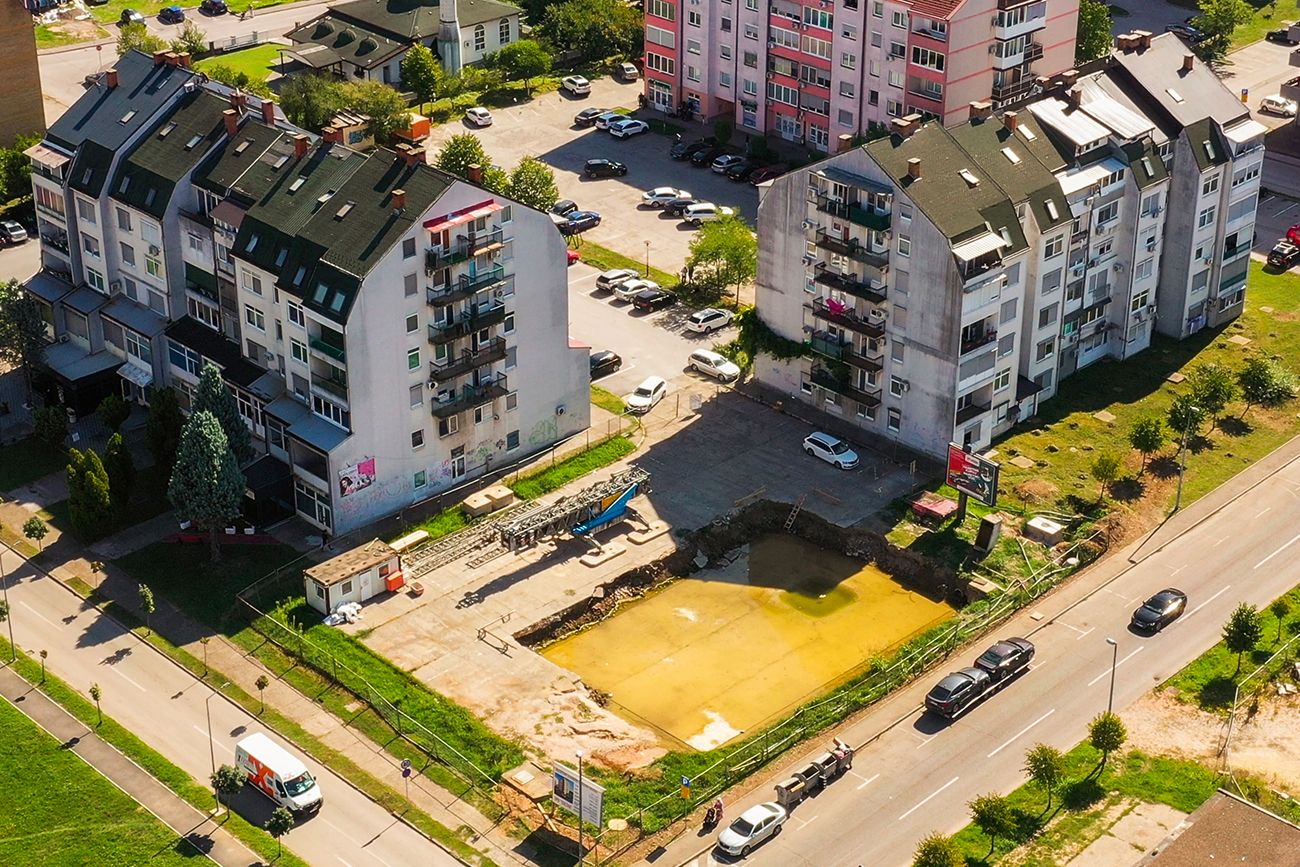
“What logic is there in increasing a plot by 102.8 per cent under the pretext of adjustment?” asked lawyer Omerović, who has since filed multiple criminal complaints.
Sarajevo lawyer Ismet Velić told CIN reporters, without commenting on the sale of the land to Sultan, that plot adjustment does not entail granting the same or a larger plot.
“We’re talking about a limited adjustment to a plot that already exists. There’s a plot intended for construction, structures are being built, but there’s a certain deficiency that really needs to be addressed. It’s usually on a smaller scale,” explained Velić, clarifying the purpose of plot adjustment.
Sale via public tender quadruples the value
In September 2024, the Imširović family, private entrepreneurs in Lukavac, learned that the city authorities had announced a public tender to sell a plot adjacent to their home. Court expert Faruk Omanović valued the 91-square-metre plot at 10,236 BAM.
However, with three other bidders appearing alongside Danis Imširović, the price soared fourfold during the auction, reaching 46,000 BAM, the amount they ultimately paid.
In the nearby municipality of Tešanj, about 50 kilometres west of Lukavac, authorities regulated land sales through direct agreements to prevent abuse. Their guidelines allow a building plot to be adjusted, provided it does not include more than 30 per cent of a private parcel.
Mirnes Dedukić, municipal attorney of Tešanj, explained that direct land sales through plot adjustment are carried out only when private holdings adjoin municipal land lacking independent functionality.
“For every decision, the opinion of a qualified urban planner is obtained to determine whether the plot adjustment is possible and justified in the specific case,” Dedukić told CIN reporters.
Tweaking a neighbour’s parcel
Near Lukavac’s City Hall, a residential-commercial building was planned. The regulatory plan mapped it on the part of the municipal building and land, and four private garages. All structures were slated for demolition and reconstruction.
Local company 4K & Royal, owned by Emir Krnjić and active in online sales of appliances, electronics, and tools as well as construction work, submitted the initiative. City authorities issued them planning consent.
Although Krnjić’s company owned no property on the planned site, in July 2025, they acquired an old municipal house of 58 square metres and 73 square metres of land via a direct agreement. The purchase cost the City 46,395 BAM.
Dino Begić from 4K & Royal told reporters: “That was the maximum price we were willing to pay. How much per square metre for a property that’s going to be demolished? (…) You have to demolish it to break even.
The City Attorney’s Office considered the sale lawful, and the City Council approved it.
Dino Orlić from the Department for Urban Planning, Property, and Geodetic Affairs explained that the company had entered into a joint investment agreement with the property owners.
“The plot was shaped according to their request, permits were issued to 4K & Royal. They acquired investor rights under that agreement, and the urban planning process, followed by the direct sale, was carried out accordingly”, said Orlić.
“It is very difficult to justify granting land to someone who had none to begin with,” said lawyer Ismet Velić.
“If someone doesn’t have a plot, you cannot give them something to adjust the plot. “Parcel adjustment implies supplementing an existing plot”, Velić said.
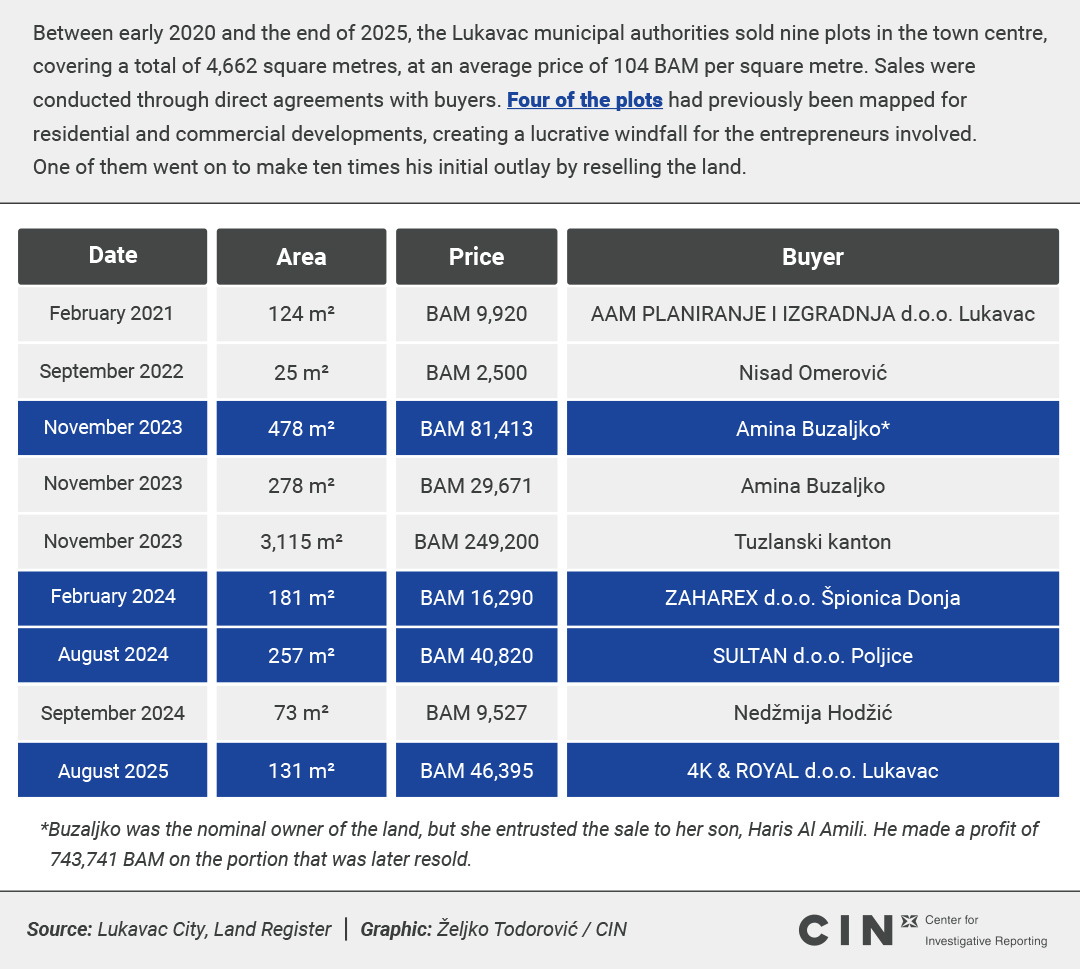
Under the same legal basis, the company Zaharex from Špionica Donja purchased 181 square metres of municipal land near Lukavac stadium in February 2024 for 16,290 BAM. Although a building was previously drawn in the regulatory plan, construction never took place.
Suad Salibašić, who chaired the City Council when the sale took place, said construction was halted due to ground instability issues. Zaharex later resold the land to Džena from Gradačac in May 2024 for 16,700 BAM.
The company Zaharex did not respond to CIN inquiries.
Although Lukavac’s City Council unanimously approved the regulatory plan in late 2022 and backed all direct sales, some councillors now express regret. One of them is Jasmin Hodžić from the Democratic Action Movement in Lukavac.
“I regret being part of it and not asking more questions. But as a councillor, I, like others, didn’t have access to all the information. Maybe we didn’t ask properly. We were told everything was in order. But looking back, how can something be sold for 80,000 and then resold for…”