

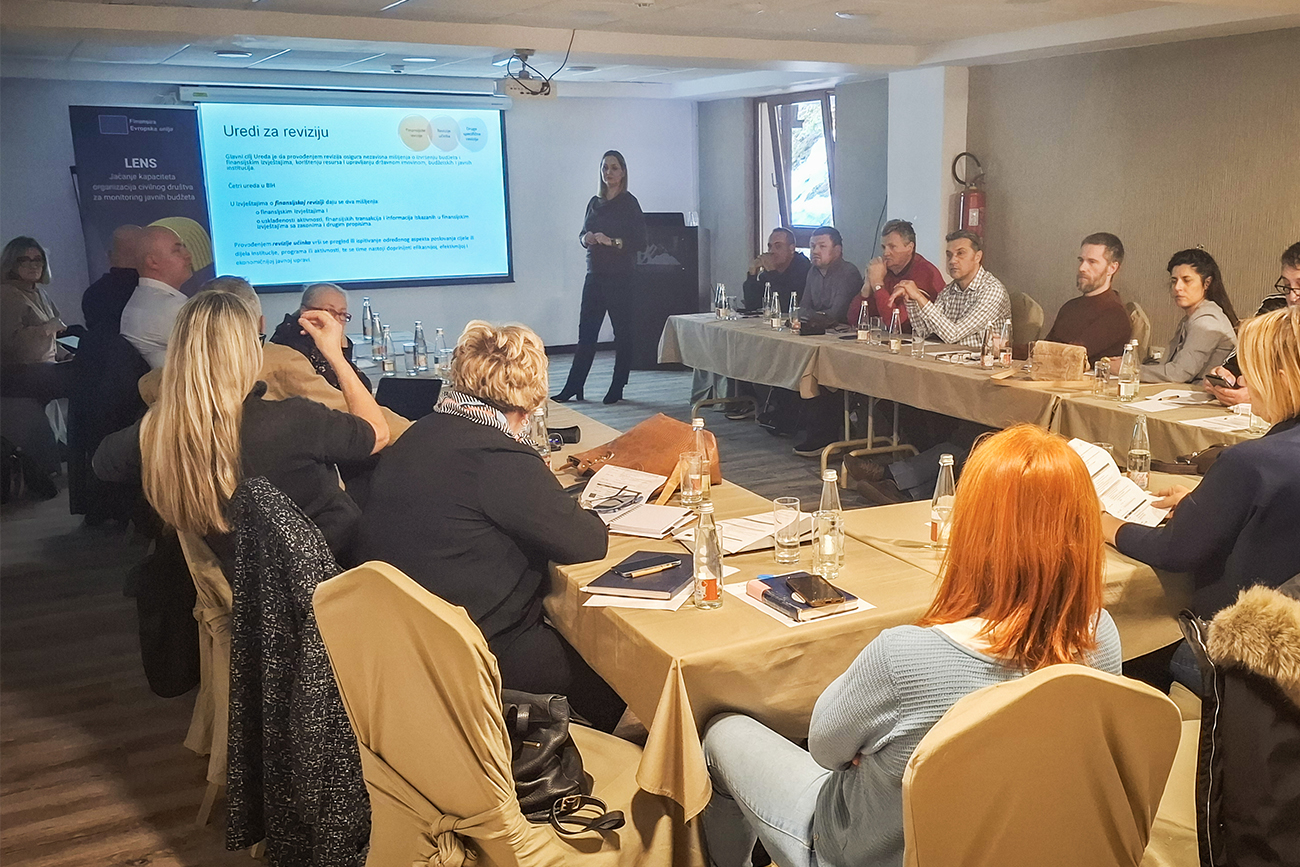
Sixteen civil society organisations from across Bosnia and Herzegovina took part in a two-day training titled “The Role of Civil Society Representatives in the Budget Process, with a Particular Focus on the Budget Adoption Phase at the Local Level”, held on Vlašić.
Civil society organisations play a crucial role in monitoring local budgets, particularly throughout the planning and adoption stages.
„That’s why this training is so important — to strengthen the capacities of local CSOs so they can engage more effectively in budget oversight within their communities, “said Marko Martić, one of the training facilitators.
During the training, civil society representatives had the opportunity to learn about the work of state-level organisations involved in monitoring public spending, as well as to explore possibilities for knowledge exchange and cooperation that could support their future activities at the local level.
Denis Džidić, Executive Director of the Balkan Investigative Reporting Network in Bosnia and Herzegovina (BIRN BiH), emphasised that any process which trains, educates, and targets greater transparency and oversight of public spending is essential to strengthening democratic capacity.
„In general, the public in BiH struggles with the idea that budgets represent their own money — funds that politicians cannot handle however they please, without any oversight, “Džidić said.
Marin Bago, President of the Futura Association from Mostar, also believes that clear shortcomings exist in the transparency of public spending: „and these can only be overcome through the active engagement of civil society, working in partnership with institutional representatives at all levels of government. “
The training was designed for representatives of local non-governmental organisations from across BiH whose work focuses on monitoring public budgets, advocacy, anti-corruption policies, and the transparency of public spending. Participants had the opportunity to learn more about the use of artificial intelligence in monitoring the planning, preparation, and adoption of budgets; the tracking of public spending by the media and investigative journalists; as well as oversight of public expenditure through the activities of Transparency International BiH (TI BiH), the Centre for Civil Initiatives (CCI), BIRN BiH, and the association Zašto ne?
This training was the third of five modules organised within the LENS project, funded by the European Union and implemented by the Centre for Investigative Reporting (CIN) in partnership with the Futura organisation from Mostar and the Centre for Research and Studies – GEA from Banja Luka. The project aims to contribute to the fight against corruption by improving the monitoring of budget spending and the use of public funds at the local level, with the active involvement of civil society.