
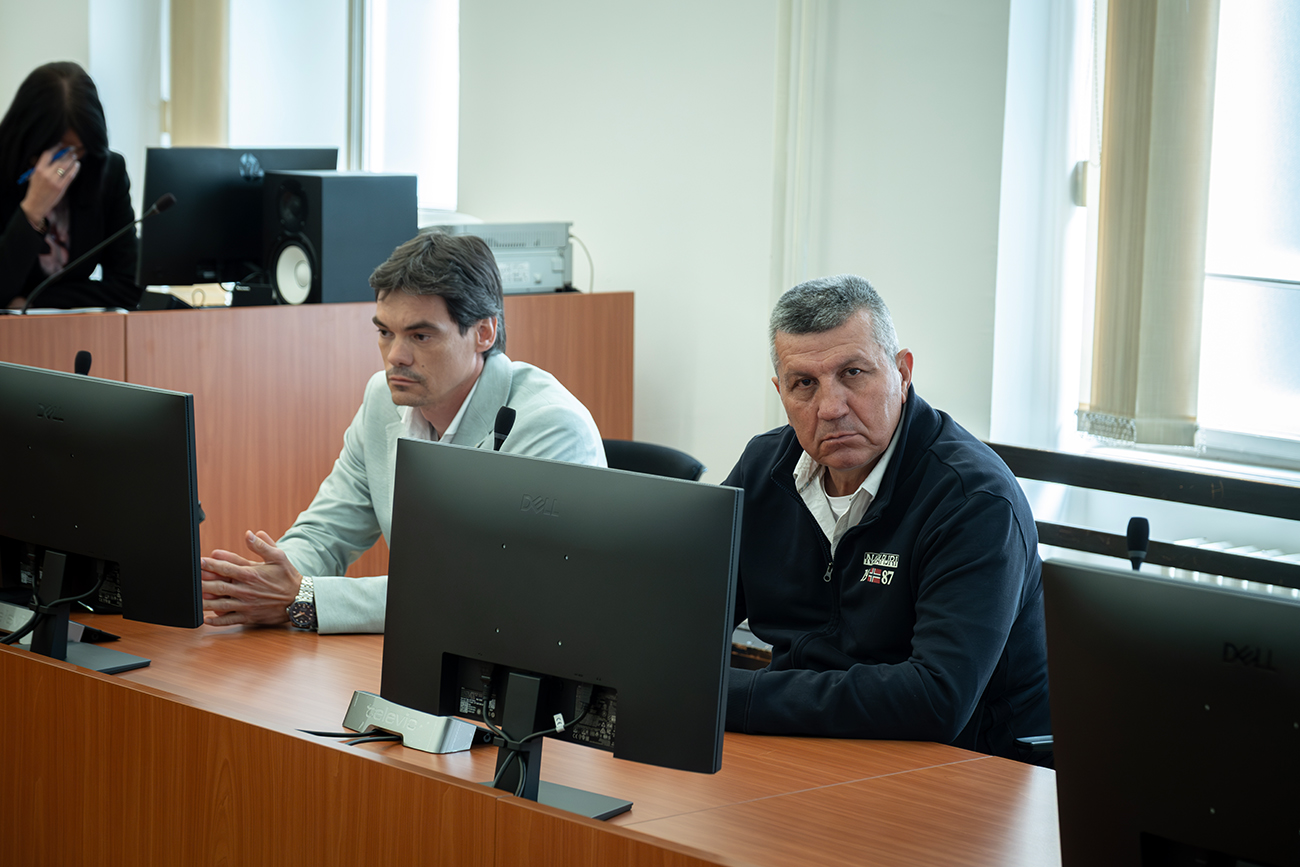
Zoran Čegar, the former head of the Uniformed Police Sector of the Federation of Bosnia and Herzegovina (FBiH), has been acquitted in a first-instance ruling of charges relating to the alleged forgery of a property sale agreement for land in Nišići.
The Sarajevo Canton Prosecutor’s Office filed the indictment in September 2024 after the Centre for Investigative Reporting published the investigation titled The Double Life of Officer Čegar.
Dragan Mirjanić, the presiding judge at the Municipal Court in Sarajevo, said that the deadline for filing an appeal would be 15 days from the issuance of the written judgment.
Prosecutors accused Čegar of knowingly submitting a forged property sale agreement — lacking both a date and signature in the name of Zoran Čegar — to the Municipal Court in Sarajevo and the Municipality of Ilijaš, despite allegedly being aware that the document was false.
During the proceedings, defence lawyer Vedad Kolašinac maintained that Čegar was innocent, arguing that the disputed contract did not bear his client’s signature and that no witness had seen him personally submit the document for property registration.
In his closing arguments, Kolašinac described the indictment as “an insult”, saying that everyone knows that a legal transaction without the buyer’s signature has no legal effect whatsoever.
He further argued that his client’s years of life and policing experience made it inconceivable that he would attempt to register ownership rights using an unsigned document.
However, Čegar’s partner, Arijana Delalić, previously testified that she had on several occasions submitted documents on Čegar’s behalf to various institutions, including the Municipality of Ilijaš.
Although she initially said that the passage of time made it difficult to recall all the details, she later stated that the documents she had delivered in Ilijaš included “some kind of contract”.
The properties in Nišići at the centre of the indictment belonged to the Sarajevo-based company Volving, owned by Mehmedalija Žmirić, who had built two houses and a horse stable on around 20 dunums of land. The buildings had never been formally registered, while the land itself remained listed in the municipal cadastre under the name of the previous owner, Radoje Ćetković.
Žmirić told the CIN that he sold the estate to Zoran Čegar in 2011 for 250,000 BAM, but claimed he never received the full amount.
Despite this, Čegar attempted to register the property in his own name in early 2019. To support the request, a property sale agreement was submitted to the Municipal Court, allegedly signed a year earlier between Čegar and Ćetković, the former owner of the land. The document bore the signature and stamp of Serbian notary Gorica Milenković from Loznica.
However, the court rejected the application after establishing that neither Ćetković nor Čegar were the legal owners of the property, but rather Žmirić’s company, Volving. The court also took issue with the fact that the contract had been processed before a foreign notary. The same contract was later submitted to the cadastre office of the Municipality of Ilijaš, where Čegar was subsequently registered as the holder of the property.
When CIN reporters checked the authenticity of the document, the Chamber of Public Notaries of Serbia stated that the documents had not been issued by any notary office in Serbia. At the time stated on one of the documents, public notaries did not even exist in the country.
“(…) starting with this power of attorney, which was allegedly certified in 2010, at a time when the Law on Public Notaries had not yet even been adopted in the Republic of Serbia. The first notary offices opened on 1 September 2014,” the Chamber’s spokesperson, Gordana Lazarević, told CIN reporters.
She also pointed to inconsistencies in the appearance of the stamp, the language and script used in the document, noting that the term “ured” for an office had been used instead of the Serbian equivalent commonly used by notaries, while the text itself was written in the Latin alphabet, which is not officially used in Loznica.
Notary Milenković expressed a similar position in a written submission to the Municipal Court in Sarajevo after being called as a witness in the criminal proceedings against Čegar. She stated that her signature had been forged and added that she saw little point in testifying as she had “no direct knowledge of the specific case”.
Čegar was later suspended and subsequently retired. After learning about the allegedly forged sales contract, the Municipality of Ilijaš launched administrative proceedings and issued a decision restoring the original records — removing Čegar as the registered owner.