
Beneath the watchful gaze of saints and angels painted across the crypt of the Church of Saint Sava in Belgrade, Serbian bishops gathered to choose a new patriarch, unaware that the devil, too, had slipped quietly into the underground hall and was peering over their ballots.
Concealed in hidden corners of the crypt and trained on the tables where the bishops sat, secret cameras recorded the Assembly of the Serbian Orthodox Church held on 18 February 2021. The cameras had allegedly been commissioned by a former state security official with close links to figures from the Balkan underworld.
Filming the Assembly was strictly forbidden. Participants had been given written assurances by the Holy Synod, the Church’s governing body chaired by the patriarch, that they would be guaranteed privacy and spiritual peace during the vote.
Yet the bishops were recorded all the same, and footage of the proceedings was delivered, within an hour of the election of Porfirije Perić as the new head of the Church, to Ljuban Ećim, the former deputy head of the Republika Srpska Security Centre in Banja Luka.
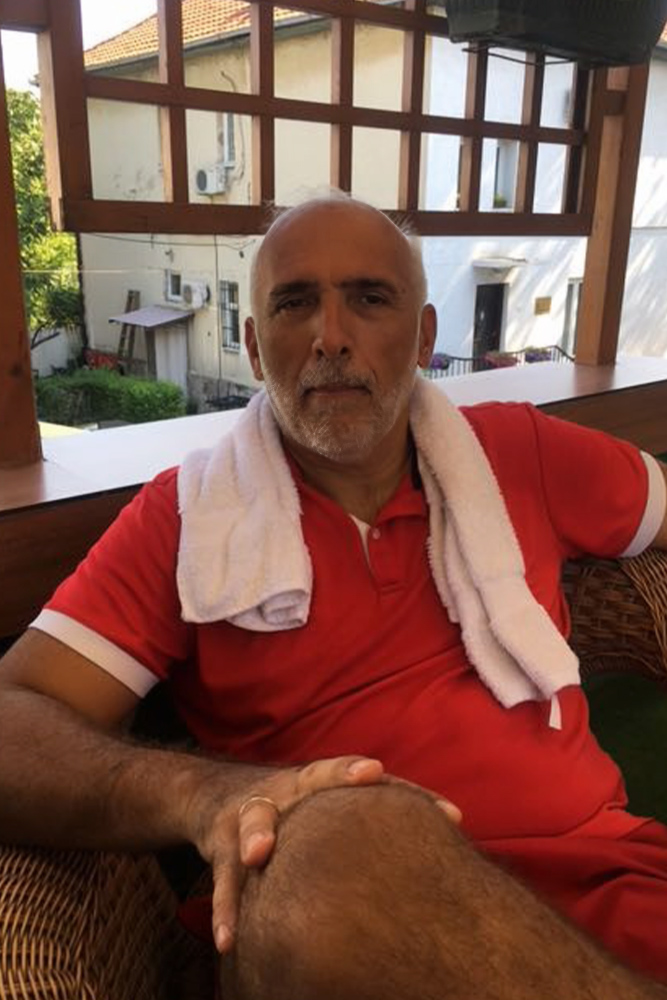
The former police official is a close associate of Luka Bojović, the Serbian drug cartel leader who returned to Serbia in 2022 after serving a decade in prison in Spain for drug trafficking offences. Both men were closely connected to Željko Ražnatović Arkan, the slain commander of Serbian paramilitary forces who was repeatedly convicted of criminal offences across Europe.
Ećim himself was sentenced in Serbia to 18 months in prison for passport forgery and illegal possession of firearms. He claimed the pistol in question had been a gift from Arkan. According to the indictment, he visited his family in Bosnia and Herzegovina under false identities, using the names Milan Njegovan and Momčilo Joksimović.
Encrypted messages exchanged via the Sky ECC app show that the convicted former officer oversaw the operation to install the hidden cameras. The correspondence was conducted with a man presenting himself as the owner of “Sion Company”, a Belgrade-based surveillance and security firm.
According to Serbia’s business registry, the company’s owner and director is Ivan Savić.
In the correspondence, Ećim used the Sky ECC code EGQOLR, while his interlocutor used the code 50NEN1. Ećim’s identifier was reportedly established by police and submitted to the Prosecutor’s Office of Bosnia and Herzegovina as part of an investigation involving an officer of the country’s Intelligence-Security Agency (OSA), Siniša Rakita. He was suspected of passing confidential information to Ećim and to criminal groups operating in Serbia and Bosnia and Herzegovina.
The owner of Sion Company and Ećim exchanged both written and voice messages, shared photographs from the Church of Saint Sava, as well as images of locations where they were present, and various covert surveillance devices.
Their exchanges suggest that certain Church dignitaries, as well as officials linked to Serbian state structures, allegedly assisted them in securing contracts at the Church, thereby granting access to locations used for covert filming.
Contracts for works in Belgrade between the Patriarchate of the Serbian Orthodox Church and the company, obtained by journalists from the Centre for Investigative Reporting (CIN), corroborate the claims made in the correspondence.
Sky ECC is a mobile phone application used for secure, encrypted communication. It was most commonly used by members of criminal organisations, as well as by individuals who feared that their activities might be exposed. The platform was decrypted in 2021 by the European Union’s law enforcement agency Europol, although monitoring of communications continued thereafter.

The Patriarch’s crypt and the Bishops’ chamber
Church authorities had, even before the formal decision on the venue of the Assembly, already settled on the idea that the election of the patriarch would, for the first time, be held in the crypt, the underground space that also functions as a church within the Church of Saint Sava on Vračar in Belgrade, and which also serves as the burial place of the late patriarch.
However, the proposal did not sit well with all bishops. Five days before the session, a letter was sent to the Holy Synod, the Church’s governing body composed of the bishops who elect the patriarch, signed by four influential hierarchs: Bishop Justin of Žiča, Bishop Ignatije of Braničevo, Bishop Joanikije of Budimlja and Nikšić, and Bishop Teodosije of Raška and Prizren.
In the letter, they expressed concern over reports that the Assembly for the election of the patriarch might be moved from the Patriarchate building, where it had been held for decades. They warned that the crypt was covered with cameras and did not provide conditions for privacy.
After the letter became public, some clergy and theologians mocked the objections in the media and on social networks, arguing that cameras could not meaningfully compromise the secrecy of the vote. They claimed the devices lacked the resolution to capture the text on ballot papers and that, in any case, they would be switched off or covered.
At its session on 10 February 2021, the Synod decided that the Assembly would be held eight days later in the crypt of the Church of Saint Sava, citing the need to facilitate compliance with COVID-19 public health measures. The larger space also allowed participants to maintain safe physical distance.
By that time, however, Church dignitaries had largely not adhered to such measures during prayers and other religious gatherings, despite the high risk of rapid virus transmission.
In an effort to reassure those opposed to the venue, the Holy Synod issued a notice after its session stating that the auxiliary bishop and head of the Church of Saint Sava, Bishop Stefan Šarić, had been tasked with ensuring that all internal cameras in the crypt would be switched off and covered.
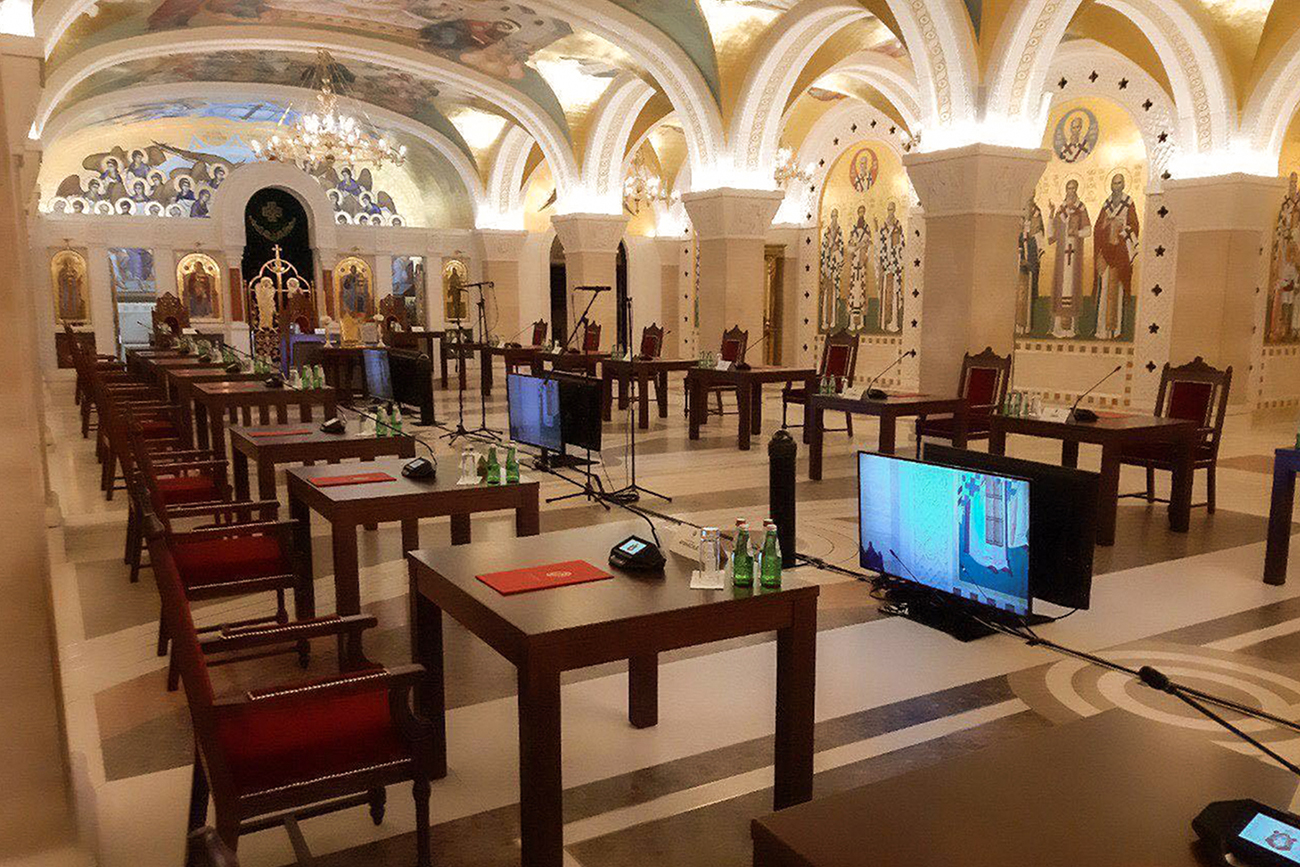
The patriarch of the Serbian Orthodox Church is elected by bishops at the Holy Assembly of Bishops. In the proceedings, 43 bishops took part, around 30 of whom were also eligible to be elected patriarch, as they had governed dioceses, administrative units of the Church, for at least five years.
In the first round, each bishop writes three names on a slip of paper. The electoral commission then counts the votes and selects the three candidates with the highest number of votes.
At the Assembly held in the crypt of the Church of Saint Sava on 18 February 2021, the shortlist consisted of: Metropolitan Porfirije of Zagreb and Ljubljana, Bishop Irinej of Bačka, and Bishop Jefrem of Banja Luka. Their names were then placed into three envelopes, which were inserted into a copy of the Gospel, the part of the New Testament that describes the life and teachings of Jesus Christ.
A monk, previously selected by the Assembly of the Serbian Orthodox Church, then draws one envelope at random, thereby electing the patriarch. This so-called “apostolic method” of selection was introduced by the Church in the late 1960s in order to reduce the possibility of interference by the communist authorities in the election of the patriarch.
Camera can see through the speaker grille
However, even before the Church authorities had promised to switch off the cameras, preparations were already underway in the crypt for the installation of a parallel, covert recording system. The day after the protest letter from the four bishops, Ljuban Ećim and the owner of Sion Company discussed via the Sky ECC the installation of hidden cameras.
They initially considered embedding them inside microphones placed on the bishops’ tables, but the idea was dismissed, as even minor movement of the microphones would, they concluded, disrupt the camera focus.
“It’s very close, and any movement will disturb the focus on what needs to be captured,” the company owner noted.
They also considered concealing cameras inside table lamps, but after inspecting the crypt, the owner of Sion Company proposed a better solution.
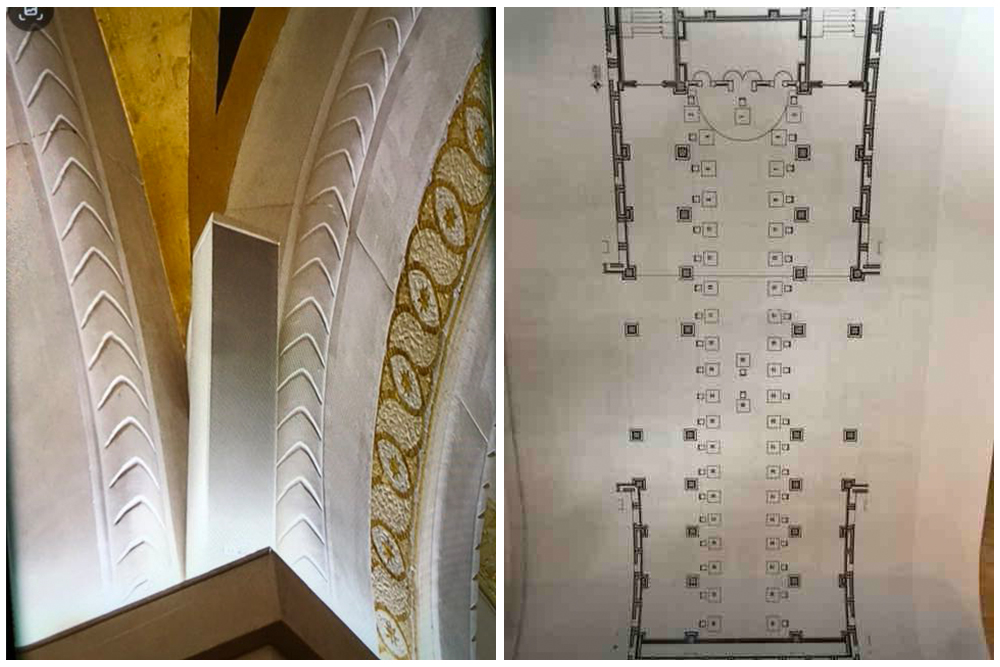
He sent Ećim a photograph of the existing public address system with the message:
“This is a speaker installed on almost all columns. We can fit everything inside it.”
Ećim agreed, but asked: “Can we see into every corner?” He was then sent another image showing a floor plan of the crypt with around 40 marked bishops’ tables.
“We have columns above all the tables. We just need to add speakers on all sides,” the Sion Company owner explained.
Their exchange suggests that a covert camera system was intended to be installed in the crypt and controlled via Wi-Fi. The system was designed to operate separately from the existing surveillance infrastructure, with cameras equipped with their own memory cards.
CIN journalists established that the loudspeakers shown in the Sky correspondence are still present in the crypt.
Three days later, the company owner informed the former security official of a potential solution, i.e., installing discreet yet functional cameras inside the loudspeakers.
“We found a camera that can see through the mesh. There are no holes in it. Nothing is visible, and the image quality is excellent,” he wrote.
Around midday on the day of the Assembly, while voting was still in progress, Ećim used Sky ECC to ask the Sion Company owner about the footage. The owner replied that he would retrieve the recording and deliver it to him personally.
“We’ll need a copy,” Ećim wrote.
“I’ll give you an external hard drive, and we can copy it as much as you want,” the company owner responded.
An hour after the announcement of the new patriarch, the two met in a restaurant in Belgrade to exchange the recording from the Assembly.
Journalists from CIN contacted several individuals, including his former lawyer, in an attempt to reach Ljuban Ećim, but were unable to do so. He was not present at the locations in Belgrade where, according to court documents, he was formally registered, and he did not respond to messages left by journalists at a café in Banja Luka run by his son.
It can be done without the Synod
In parallel with resolving technical issues related to covert recording, the two interlocutors were also coordinating details of a potential offer and contract with the Serbian Orthodox Church for video surveillance services, as well as the supply of loudspeakers and cameras for a conference system.
According to documentation obtained by CIN journalists, Sion Company secured a contract in June 2020 for the installation of a complete video surveillance system at the Church of Saint Sava. However, the contract did not include control or monitoring of that system.
As the patriarchal election approached, this gap was addressed shortly before the Assembly in February 2021. At the same time, the Church required an additional procurement for the major event – an electronic conference system. Such systems typically involve a network of speakerphones, cameras, and screens enabling participants to follow proceedings without interruption.
Via Sky ECC, Ećim suggested that their bid should be the cheapest, and that the then head of the Church site and chair of the procurement commission, Bishop Stefan Šarić, should be told to select the most cost-effective offer. The owner of Sion Company informed him that, as agreed, he had submitted the bid to the parish house for Bishop Stefan, and that he had “included a few things” in the folder as instructed by Ećim.
On the same day, Sion Company was instructed to send the contract to the Patriarchate’s official email address, while Ećim told the company owner to “call Škrinjar” and bring the invoices and the contract.
Dragan Škrinjar was a member of the Commission for the Selection of Bidders within the Committee for the Completion of the Church of Saint Sava. In Church documents from 2019, he signed as a rep of the Presidency of the Republic of Serbia. Reps of state authorities took part in the committees and boards overseeing the construction of the cathedral, as the government had donated millions towards its completion.
Škrinjar did not respond to journalists’ calls, while Stefan Šarić, now head of the Serbian Orthodox Church’s metochion in Moscow, the Church’s official representation to the Russian Orthodox Church, declined to comment for CIN.
The implementation of the contract proceeded rapidly. The owner of Sion Company complained to Ećim that the contract had not gone through the usual approval procedure in the Synod, and expressed surprise that documents on behalf of the Church were to be signed by a Patriarchate official, Dejan Simeunović. “Come on, that’s ridiculous. Dejan has no real authority here,” he wrote to Ećim.
“Why do you care who signs it, as long as you get the money?” Ećim replied. “Don’t worry about whether he has a formal position.”
Simeunović denied to CIN that he had any contacts related to the awarding of this contract.
The contract was ultimately formalised by the future patriarch. Shortly before the Assembly, Sion Company and then-bishop Porfirije Perić, acting as the Church’s representative, concluded a contract for monitoring and maintenance of the video surveillance system, with a monthly fee of €13,260.
This exact amount had previously been agreed in correspondence between Ećim and the owner of the Belgrade-based company that won the contract. The contract was concluded for a period of ten years, allowing Sion Company to generate an estimated €1.59 million in revenue by 2031.
Dejan says it’s fine, but Mira won’t pay
Although its delivery had not been formally contracted, the electronic conference system had already been installed in the crypt, and participants at the Assembly were able to use it, as shown in photographs and video footage recorded ahead of the gathering.
The correspondence suggests that the Holy Synod had not formally approved the arrangement, leaving the owner of Sion Company uncertain about the deal. Ećim, however, reassured him that this would not be a problem because “Dejan” – or simply “D”, as he was referred to in the messages – had authorised the arrangement.
This Dejan appeared to wield considerably more influence within the Patriarchate than the aforementioned Dejan Simeunović. A figure fitting that description is Dejan Nakić, a close associate of both the former and current patriarch.
When approached by journalists, Nakić said only that such matters were not within his remit and were handled by bishops. He declined to comment further.
The arrangements nevertheless had to be formally legitimised, and a contract for the supply and installation of the system was eventually signed on 11 March 2021, around twenty days after the election of the new patriarch. Once again, the agreement was signed by Porfirije, this time in his capacity as head of the Serbian Orthodox Church. According to the contract obtained by CIN, the system cost the Church 18 million Serbian dinars, approximately €150,000.
It soon became clear that not everyone within the Patriarchate agreed with the way the business had been conducted, and the owner of Sion Company spent days attempting to secure payment for the completed work.
“Bro, Mira refuses to sign those two invoices. Mira won’t authorise payment because there isn’t a separate contract for each of them,” he complained to Ećim in a voice message sent via Sky ECC in early March. “She lectured me for half an hour about it, and in the end, she won’t pay until the Synod approves it,” he said.
Upon learning that “Mira from finance” was involved, Ećim reassured him that everything would be paid.
Following these contracts, the doors of the Patriarchate were effectively opened for continued cooperation. By the end of 2021, Sion Company had signed four additional contracts with the Church: the procurement of a simultaneous interpretation system and an advanced digital radio communication system, as well as two separate purchases of additional video surveillance equipment.
The total value of the contracts amounted to approximately €236,000, and they were signed on behalf of the Church by Patriarch Porfirije and Bishop Stefan Šarić.
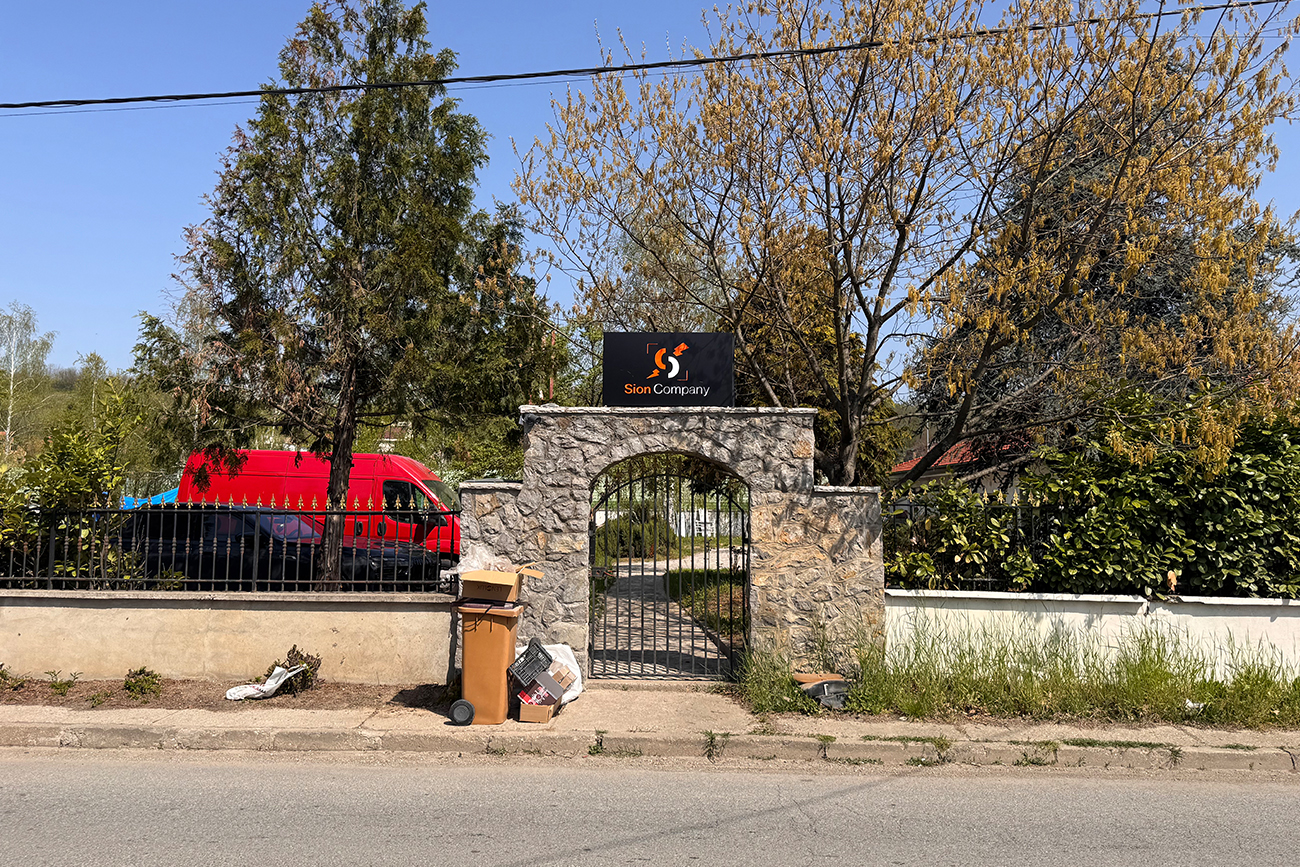
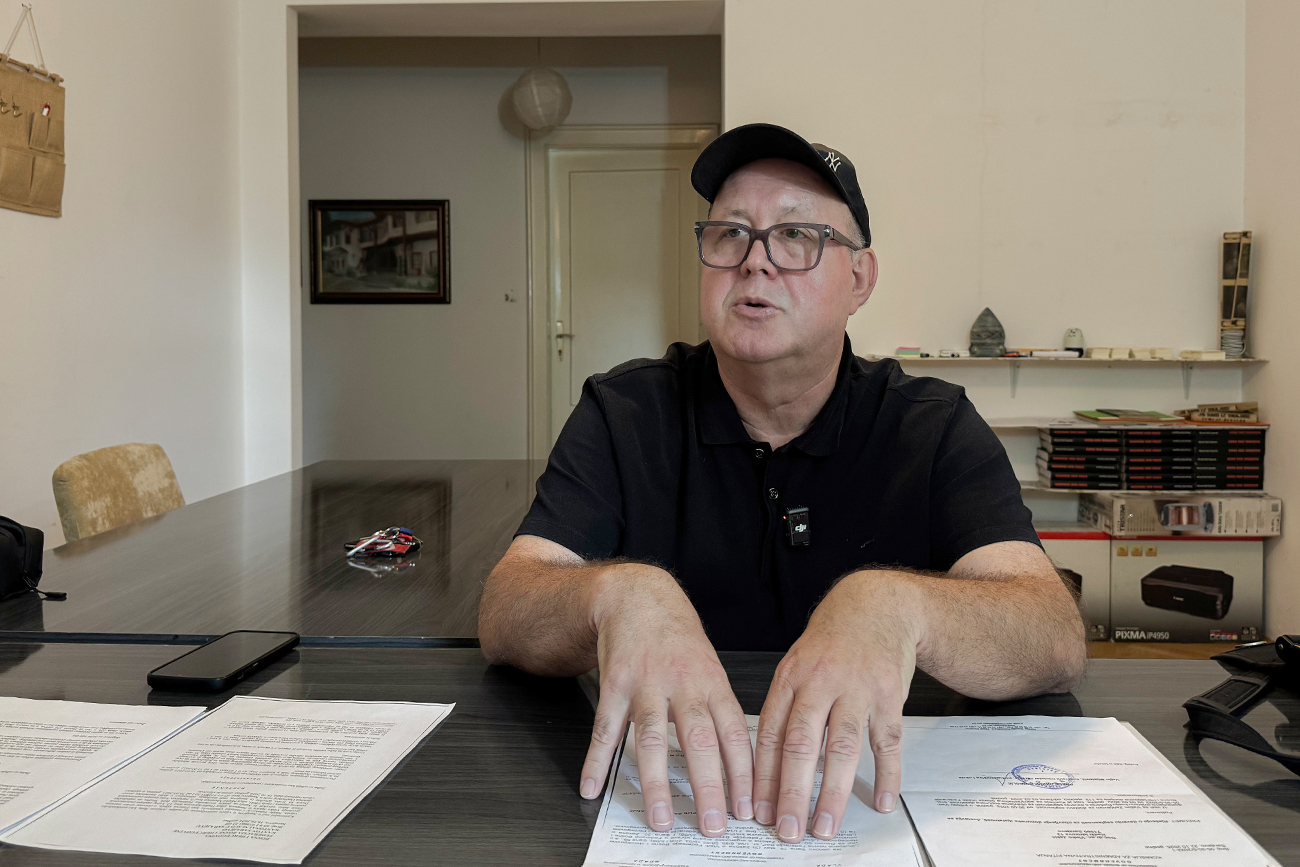
Ivan Savić confirmed to CIN journalists that he is the company’s owner and director, and that he does business with the Church.
He was interviewed within the company’s premises on the outskirts of Belgrade. He declined to allow the conversation to be recorded, but stated that he did not know Ljuban Ećim and had no involvement in any covert cameras.
He explained that there are eight cameras in the crypt, installed long before his company received its first contract in June 2020, and that they are switched off two days before each Church Assembly at the request of the Church.
He added that he was almost certain there were no cameras inside the loudspeakers mounted on the crypt walls, but said he would nevertheless open them to verify journalists’ findings. He concluded that he would not inform them of the outcome.
CIN journalists spoke with Savić for just over half an hour. After later reviewing three voice messages sent by the Sion Company owner to Ećim via Sky ECC, they formed the impression that the voice and diction closely resembled that of Savić.
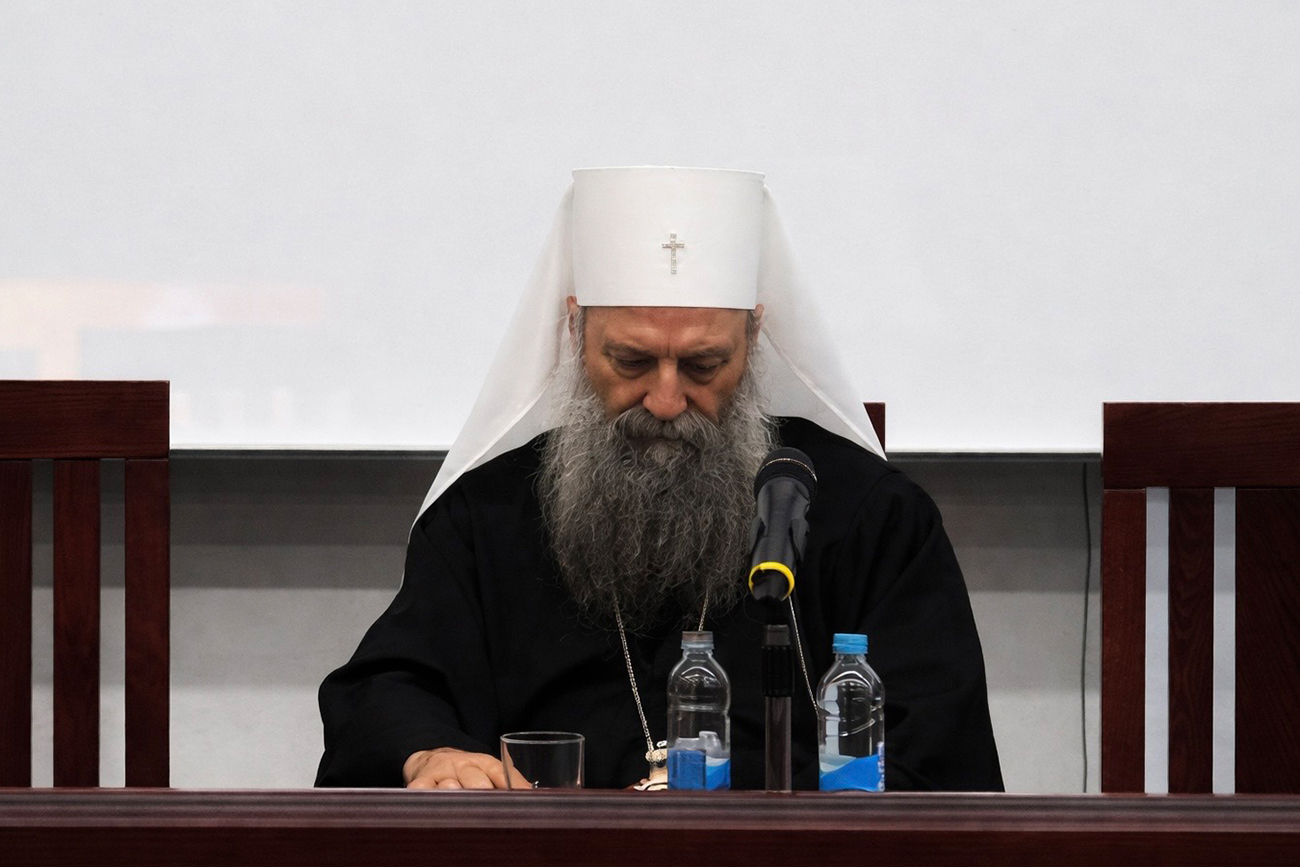
CIN also attempted to speak with Patriarch Porfirije ahead of his appearance at the Faculty of Law in Banja Luka in March 2026. He briefly approached journalists upon request, but the organisers did not allow an interview. The CIN subsequently submitted written questions to the head of the Serbian Orthodox Church, the Holy Synod, and the Church’s Public Relations Service regarding the disputed dealings ahead of and during the 2021 electoral Assembly, but no responses were received.
Journalists also attempted to speak with several senior Church figures, including Metropolitan Joanikije and Metropolitan Grigorije. None agreed to comment.
Theologian and editor of the portal Teologija.net, Blagoje Pantelić, and former parish priest of the Church of Saint Sava, Vukašin Milićević, have for years written and spoken about the alleged links between the Church, the political establishment of Serbian President Aleksandar Vučić, and elements of the Serbian underworld.
In January 2026, both were subjected to the Church’s most severe disciplinary measure following public statements in which they criticised the Church leadership and its relationship with the authorities: the Ecclesiastical Court of the Archdiocese of Belgrade and Karlovci sentenced them to permanent excommunication from the religious community.
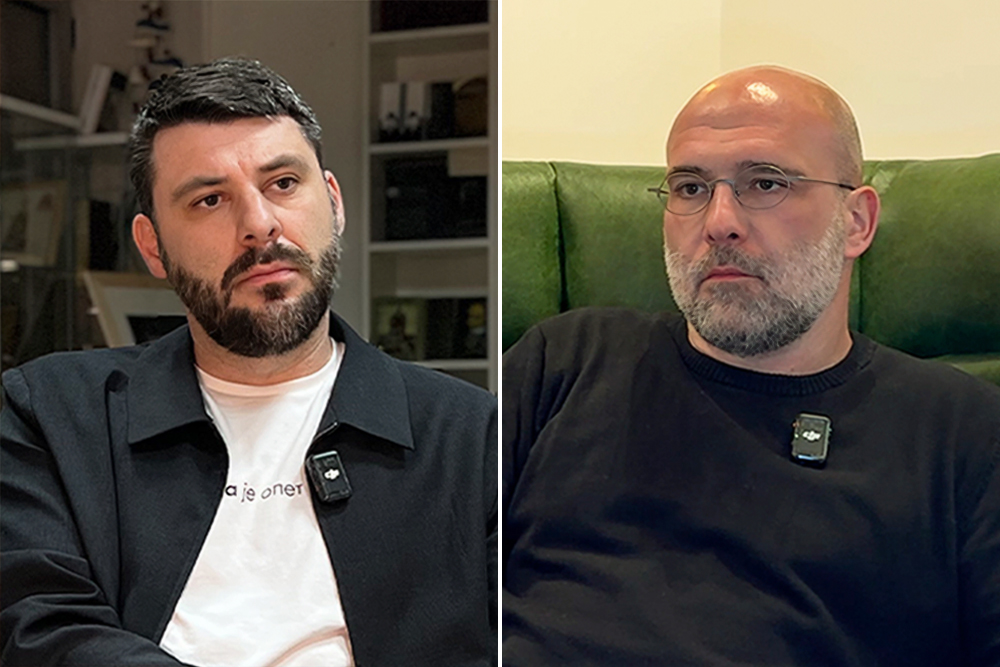
Neither of them had seen the Sky messages, but they said CIN’s findings did not surprise them. Milićević claims that, according to information from Church circles, the covert recording was directed at those bishops who were wavering in their support for candidates. He argues that he has heard from multiple sources that the patriarchal election was preceded by a campaign in which certain members of the Government of Serbia played a decisive role.
“They went around everyone they knew could be influenced, probably around two-thirds of the bishops, and they had concrete demands,” Milićević said.
He explains that for years he has argued that organised crime is a structural problem that has taken hold of both the Serbian state and the Church.
“So these are all tentacles of the same organised criminal group. And that’s how the mafia operates – not on trust, but by blackmailing one another, right? So the multiplication of the recording likely serves both to protect those directly involved in its creation and the broader web of illegal activity, and to provide them with a kind of guarantee for their future safety and immunity from prosecution,” Milićević said.
Pantelić believes that, after the revelations about the recordings, the Church should immediately form a commission to determine what actually happened, who carried it out, why, and whether hidden cameras are still present in the crypt.
“For me, it is shocking and scandalous that the election of the head of the Serbian Orthodox Church appears in Sky communications, and not as casual café talk between two people on Sky phones, but involving people who organised an operation that was part of that entire process,” he said. “That is a scandal in itself,” Pantelić believes.
On the day of the electoral Assembly, Ećim also communicated via Sky ECC with friends from Bosnia and Herzegovina. One of them, from Banja Luka, sent him a brief message: “Porfirije”.
Ećim replied with a boast: “He was our first pick. (…) We knew two days in advance.”
Indictment for war crimes in Bosnia and Herzegovina
In December 2019, the Prosecutor’s Office of Bosnia and Herzegovina filed an indictment against Ljuban Ećim for crimes against humanity and war crimes against the civilian population in Kotor Varoš. One month later, the Court of Bosnia and Herzegovina dismissed the indictment. During questioning, Ećim stated that he could only respond to the allegations once the Republika Srpska, i.e., Bosnia and Herzegovina, released him from obligations to protect state and official secrets. The court found that proper procedure had not been followed and that Ećim had not given testimony.
The Prosecutor’s Office has not yet had the opportunity to correct this issue, as Serbian authorities claim they are no longer able to locate Ećim at his known addresses.
The former security official is suspected of having participated, as deputy commander and de facto head of the Special Police Unit of the Banja Luka Security Centre, in a joint criminal enterprise targeting the civilian population in the Kotor Varoš area from early June 1992 until mid-1994.
The indictment alleges that, during military and police operations, dozens of civilians were killed, hundreds forcibly displaced, detained, and tortured, while property, cultural monuments, and religious buildings, including 15 mosques and eight churches, were looted and destroyed. Among the victims were women, children, and members of the clergy.
Ećim holds citizenship of both Bosnia and Herzegovina and Serbia, and is currently the subject of an international arrest warrant.