
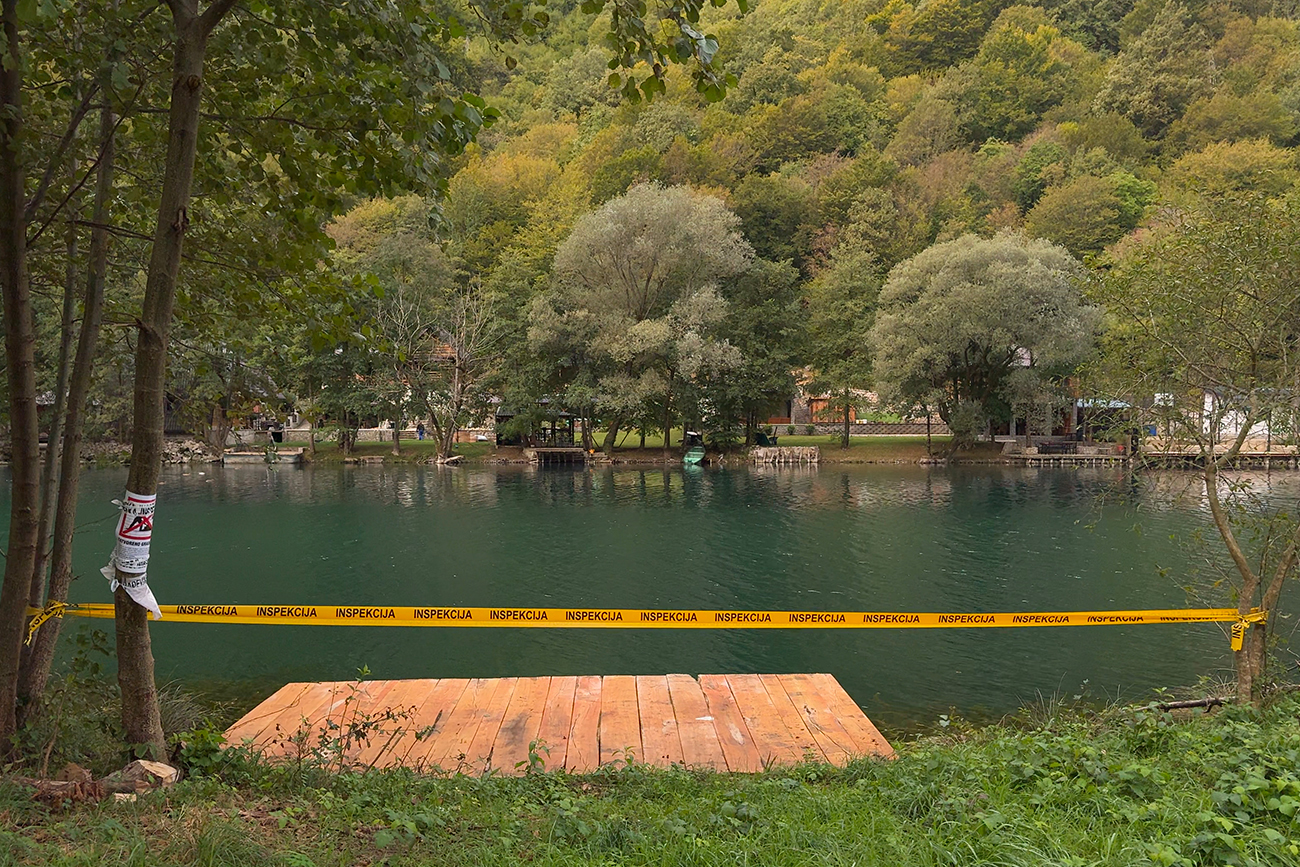
The peace of a September morning on the left bank of the Una River in Lohovo is broken by the sound of hammers. Five workers are fastening wooden boards onto the terrace of an illegally built holiday home in a strictly protected section of Una National Park, just metres from the river.
City inspectors have sealed off the site with yellow tape, ordered construction to stop, and told the workers to leave. Before long, however, they return accompanied by a group of men, forcing inspectors to call the police, who fail to respond even after threats are made against the inspection team.
Despite years of fines, owners of illegal properties in the area have continued building for more than 15 years.
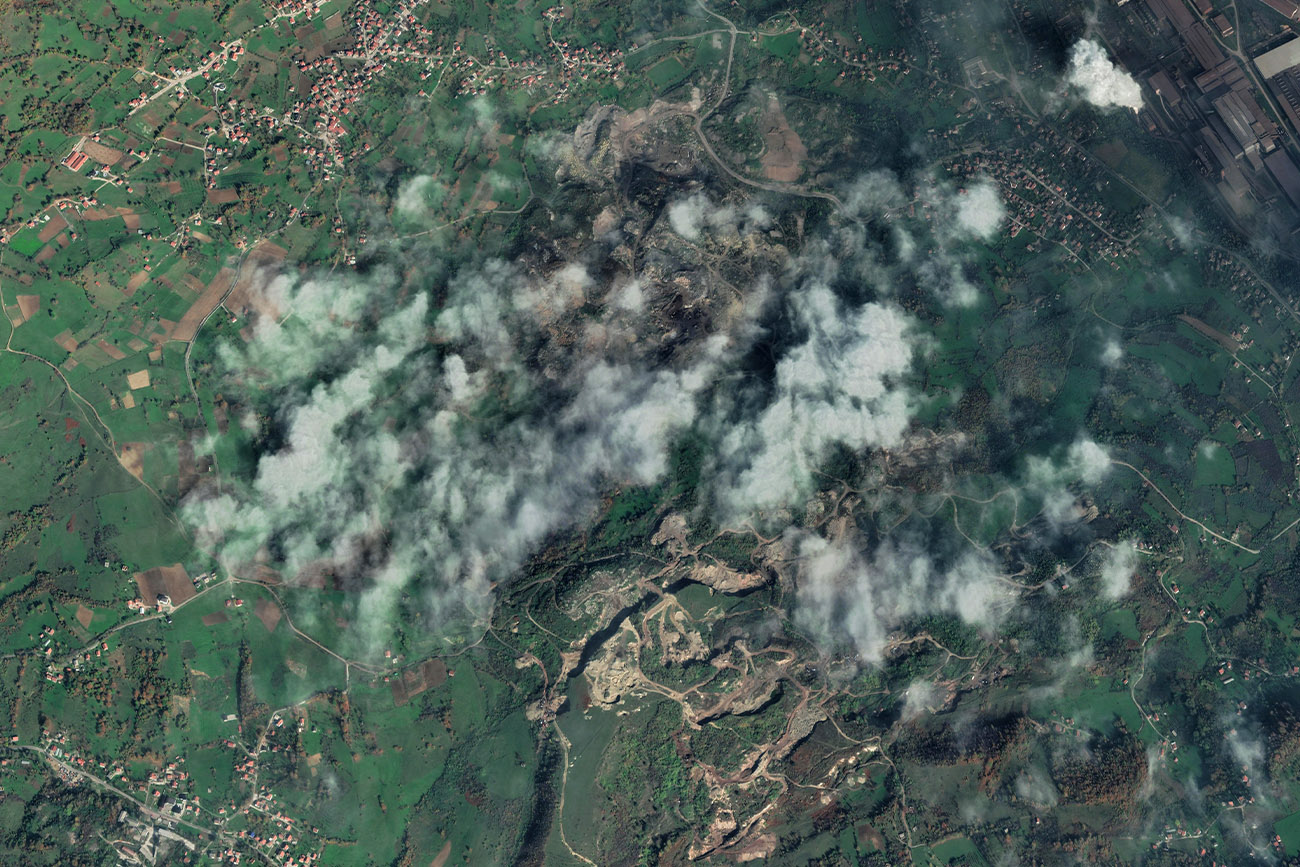
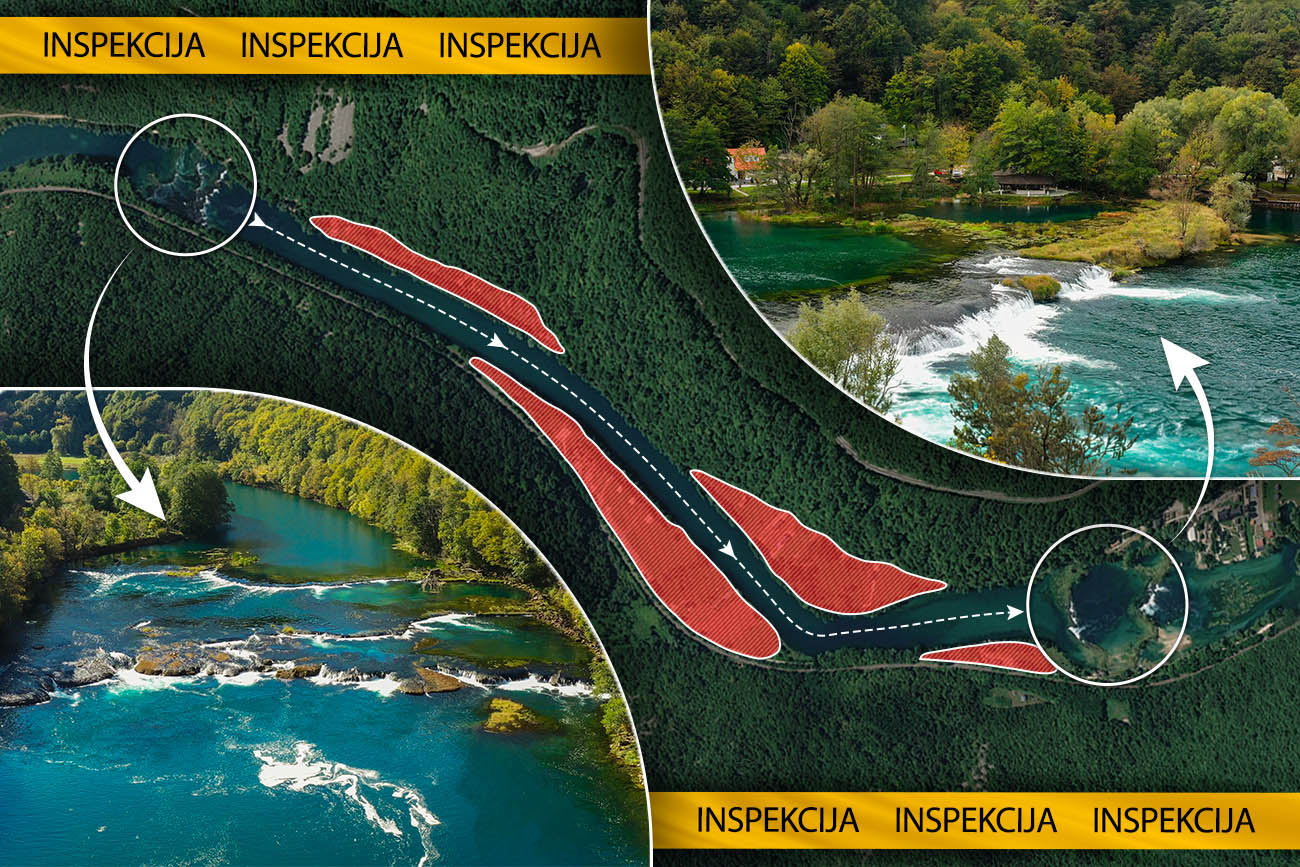
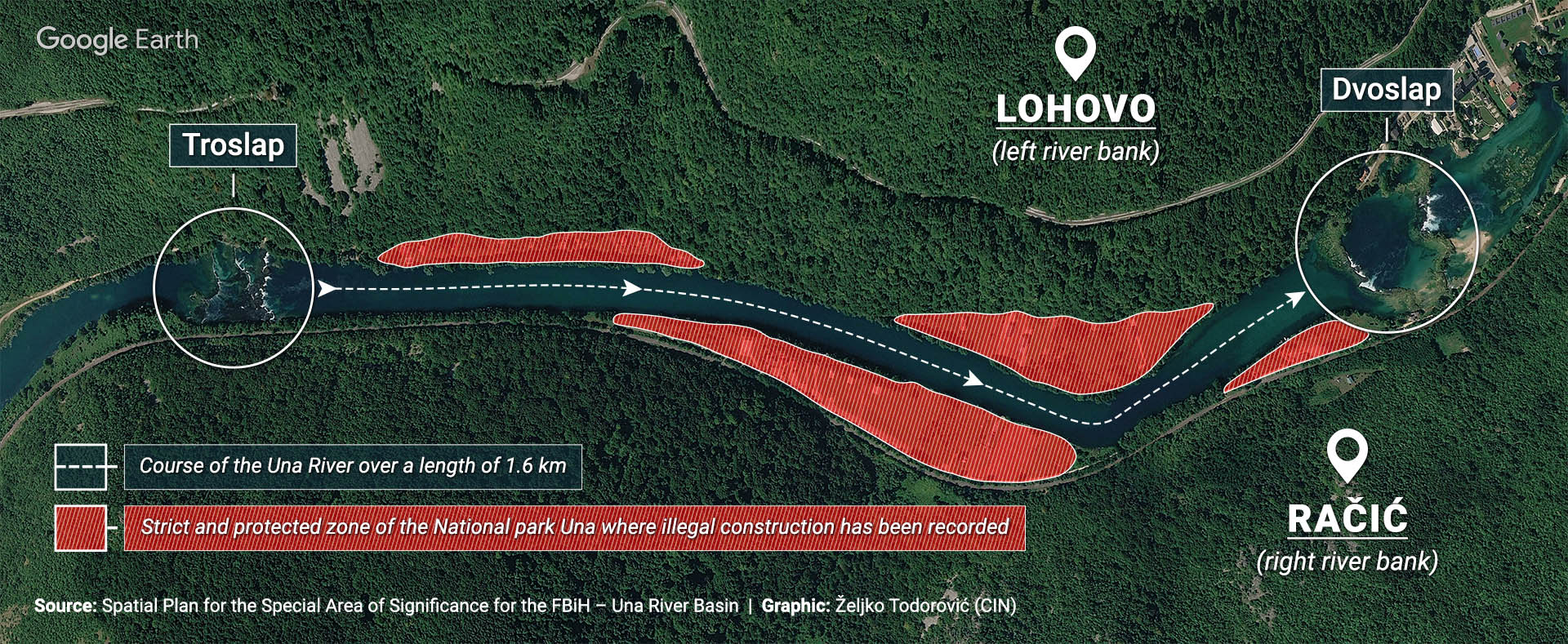
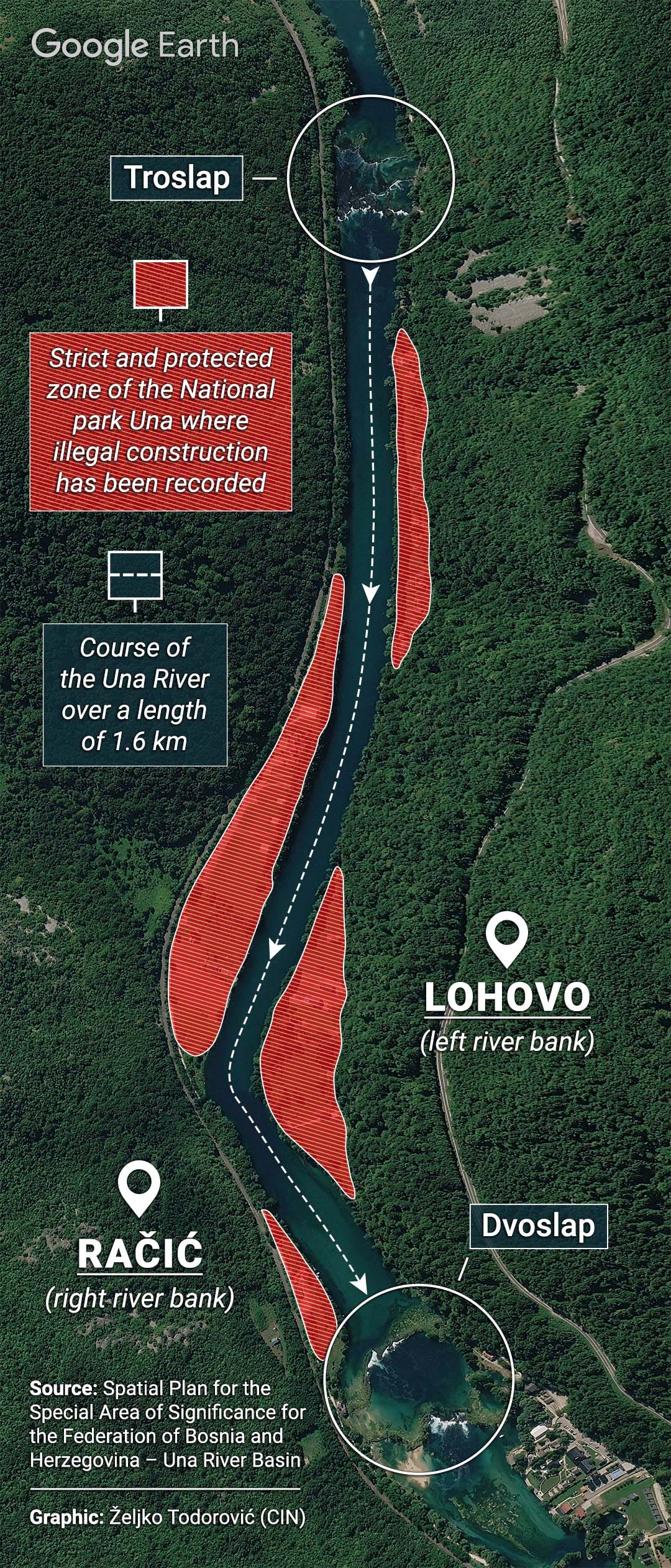
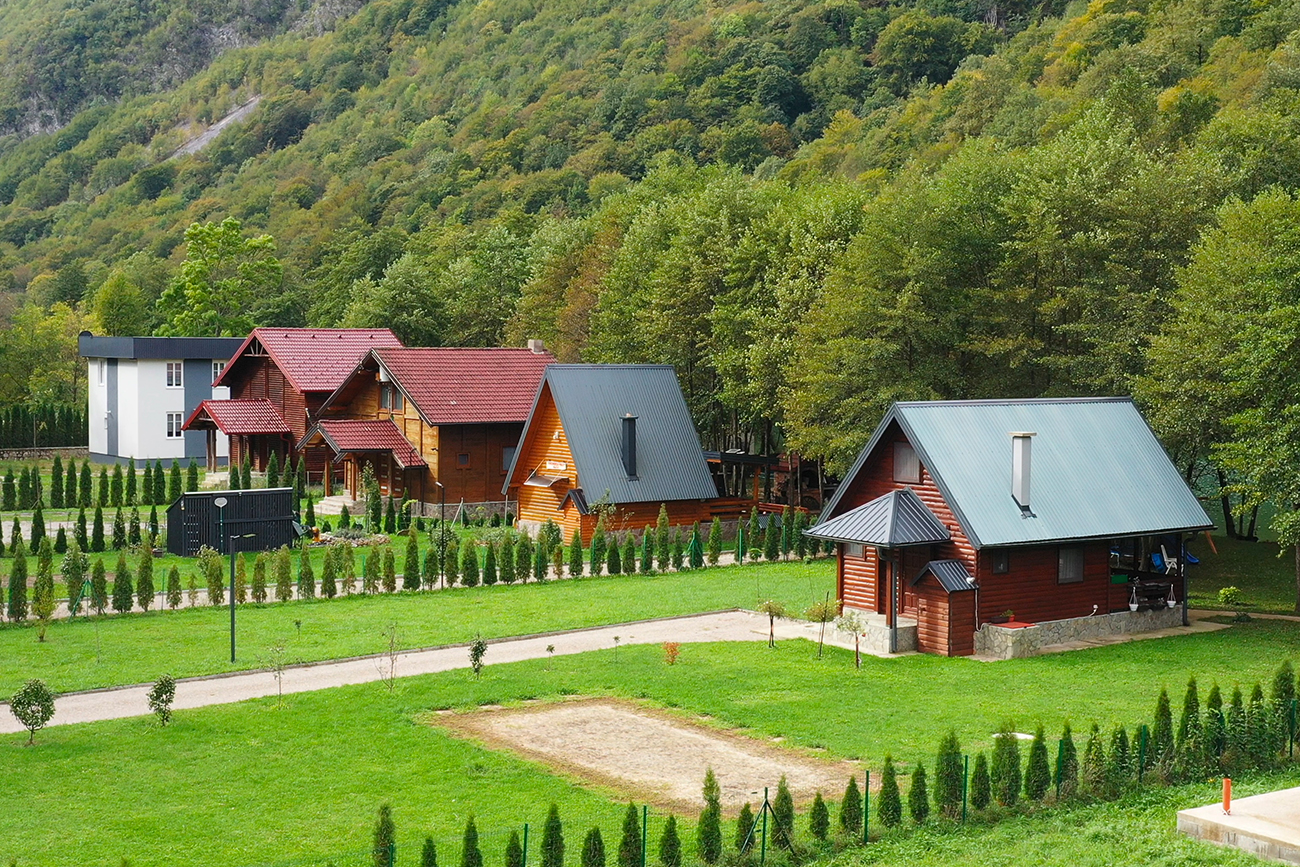
Unauthorised construction has spread across the protected zone, particularly beyond the sign marking a complete building ban between Dvoslap and Troslap, near Bihać. In the villages of Lohovo and Račić, a 1.6-kilometre stretch of riverbank has effectively been transformed into a construction site. What has emerged is an entire holiday settlement, with around 50 houses owned by locals, including police officers, businessmen, notaries, and university professors.
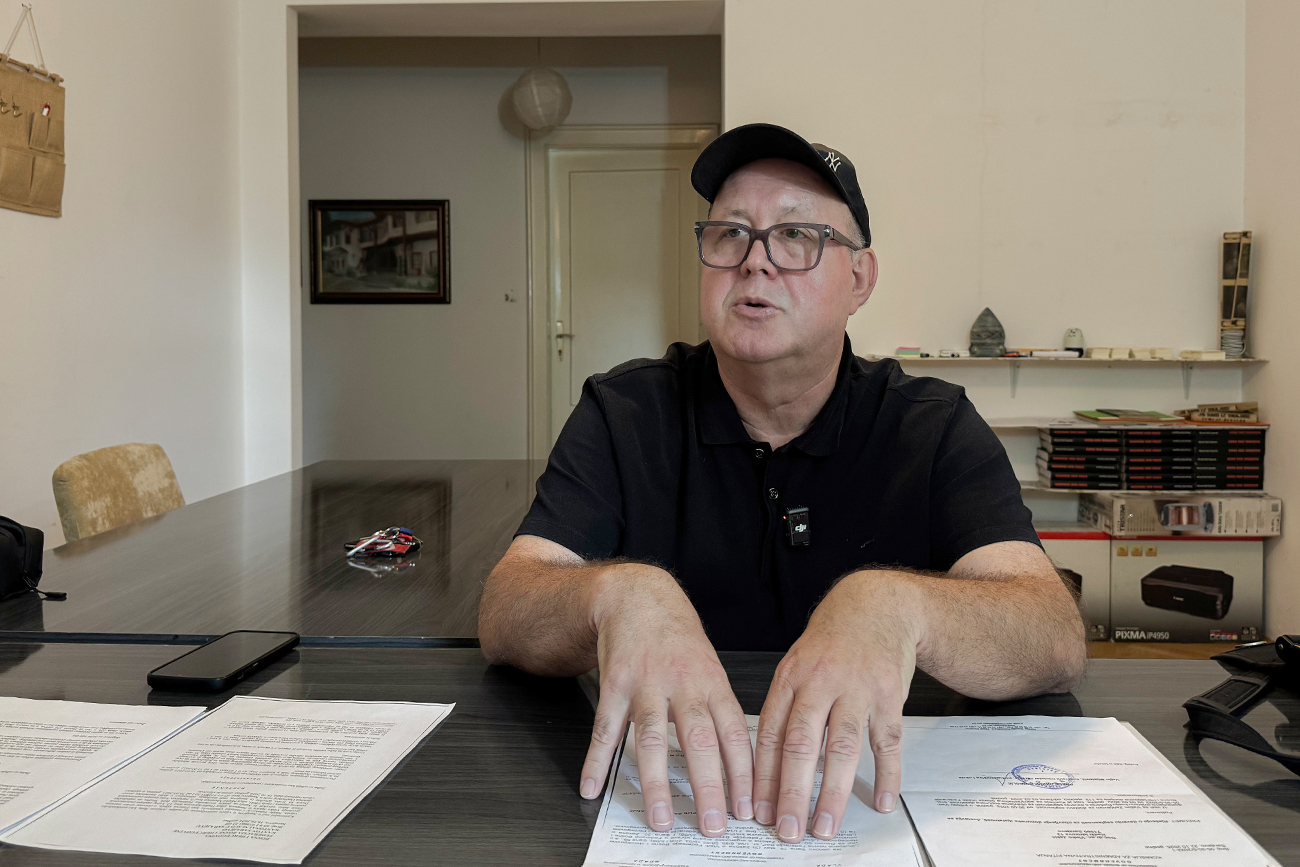
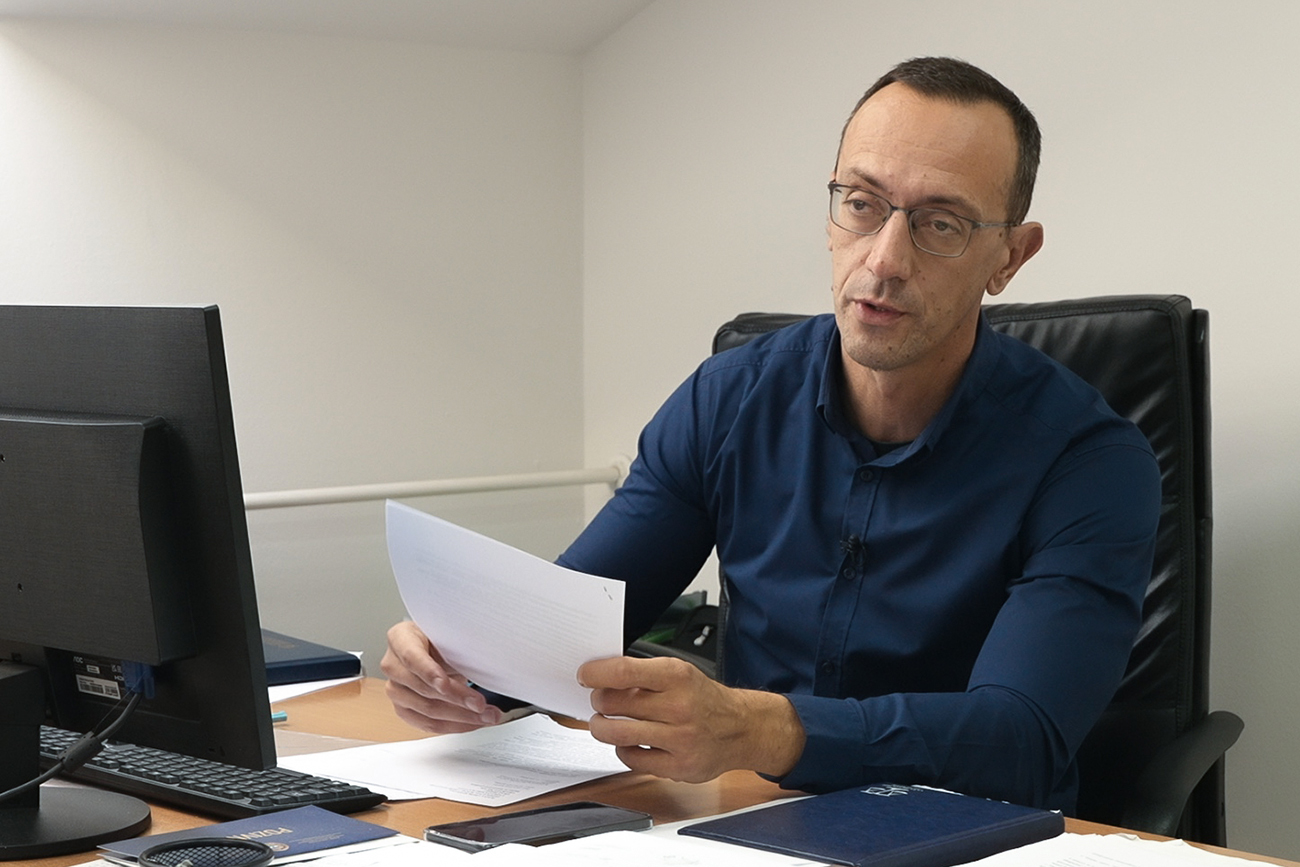
“Everyone is involved in illegal construction, and they take it as a personal insult when inspectors show up. They use whatever influence they have to try to obstruct our work,” says Anel Ramić, head of the Inspection Department for the City of Bihać.
With little backing from cantonal and federal authorities, and fearful of possible retaliation from property owners, inspectors routinely issue demolition orders for the illegal cottages but rarely enforce them.
As a result, building work continues in the heart of Una National Park. The river’s natural course is being narrowed, sewage is flowing directly into the water, and the area’s rich biodiversity is increasingly under threat, along with the fragile tufa formations for which this region is internationally renowned.

Protect, and then destroy
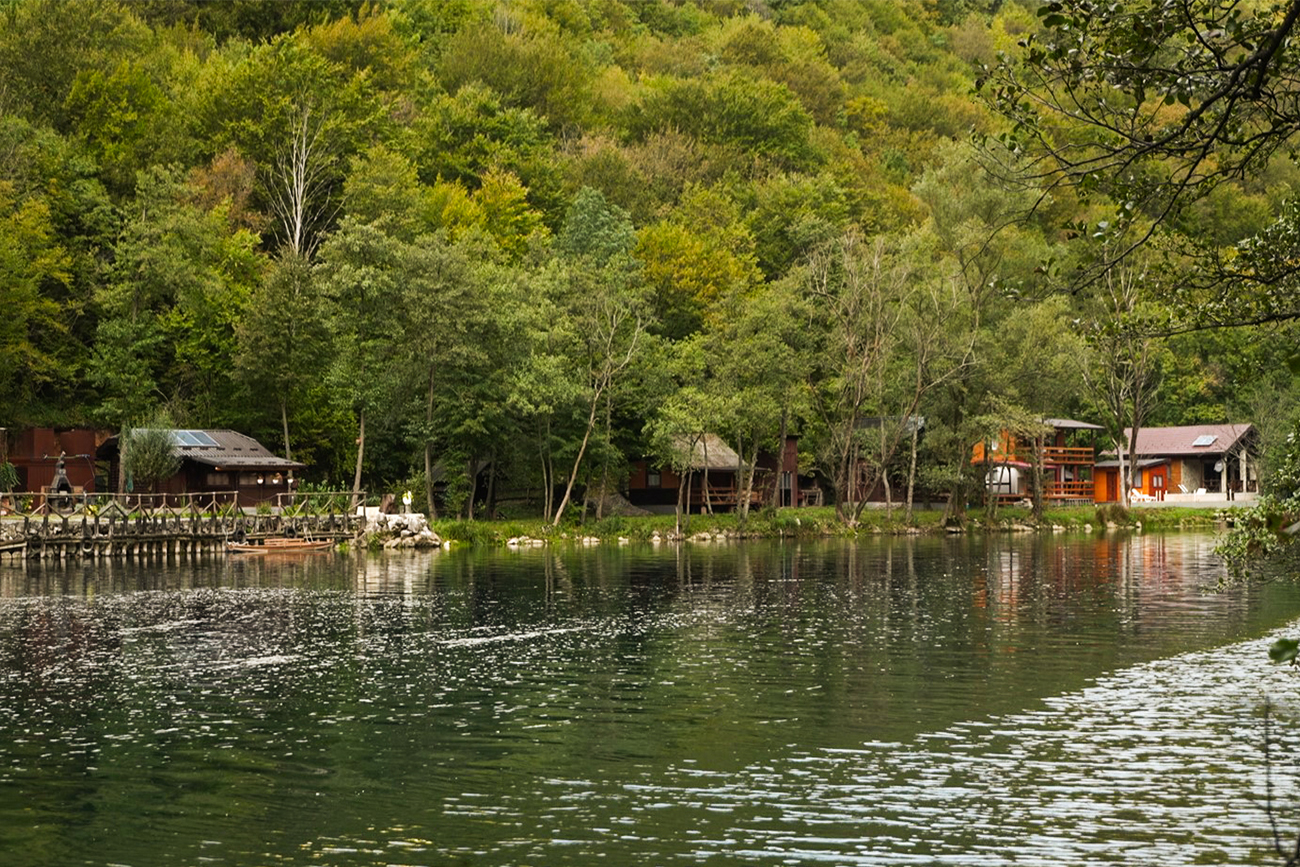
Around 15 kilometres from Bihać, the crystal-clear waters of the Una River tumble over tufa cascades, forming the waterfalls known as Dvoslap and Troslap. Here, in the canyon section of Una National Park, any human interference with natural processes has been banned since 2008 in an effort to preserve the area’s rich biodiversity, particularly its tufa formations and the microorganisms within them, nature’s own water purification system.
“Tufa stops growing once the conditions it depends on are disturbed,” says Prof. Dr Vildana Alibabić of the Biotechnical Faculty at the University of Bihać. “That happens when the temperature of the water changes, when the composition of the water changes, or when the river is polluted.”
The same strict construction ban should apply in the nearby settlements of Lohovo and Račić, at least on paper. On the ground, however, reality tells a different story. In fact, it was only after the Una National Park was officially established that construction in the area truly took off.
The first to build illegally were close friends Nijaz Sušić and Abdulah Kapo. One with money to invest, the other with dreams of a retreat by the Una.
In the autumn of 2008, Sušić bought 10 dunums of land in Lohovo. He built a two-storey holiday house and, beyond the natural beauty of the area, quickly spotted a business opportunity.
“I was selling riverside plots on the Una for 1,000 marks per square metre,” he says. (…) “I even gave some land away for free.”
According to Sušić, at the time, “one could barely get to the left bank of the Una at all”, so he upgraded the existing road himself. Despite the strict protections in place, he insists he did nothing wrong.
“I think a German would pat me on the back and say, ‘Well done for investing in this yourself.’ What I’ve done here was for the good of the community,” Sušić says.
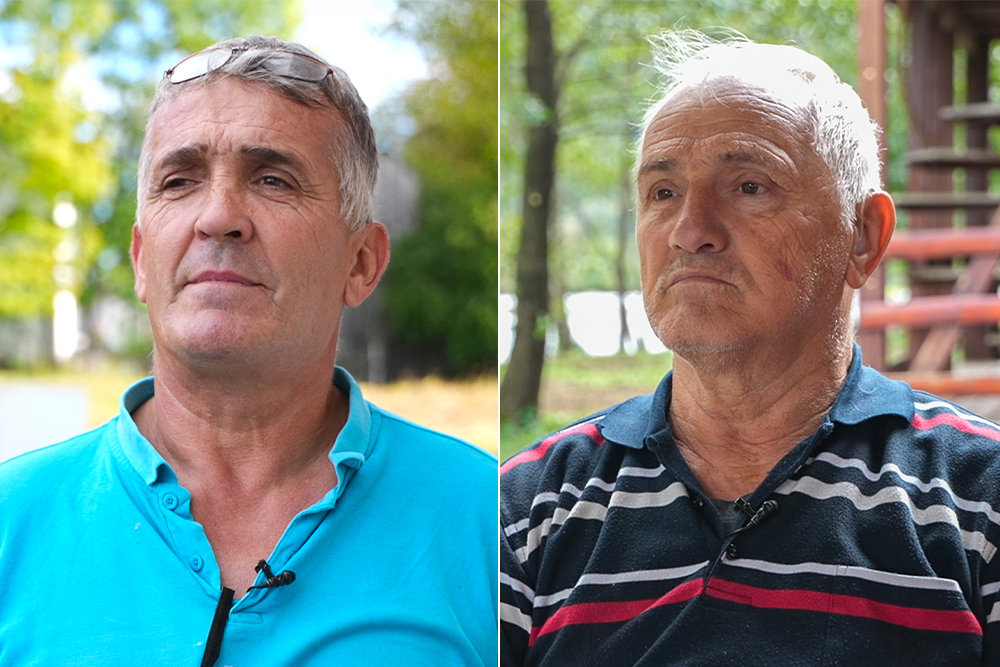
Kapo, Sušić’s close friend, built a two-storey holiday home with large terraces just 50 metres from the Troslap waterfalls. He later added a barbecue area, a covered shelter with a large wooden table and benches, and an auxiliary building where, he says, he spends most of his time. To complete the retreat, he even built a swimming pool.
“If I didn’t have this place… I’ve got a house in Ozimice (a Bihać settlement, author’s note). I’d just sit all day indoors doing nothing. This way, I come here, take a walk.”
In an effort to protect the riverbank, both men dumped rocks into the Una River, claiming the current from Troslap crashes directly into the shore and would otherwise erode their plots within a few years. They say they applied for building permits but were turned down. That, however, did little to deter them.
“I can’t wait fifty years for someone to decide when construction will be allowed, when this will become an urban zone, or whatever else,” Kapo says bluntly. “It’s my land. It doesn’t belong to the National Park.”
Environmentalists warn that sewage discharged from properties along the Una River is destroying aquatic life and river vegetation, while deforestation along the banks is accelerating erosion and increasing the risk of flooding.
“You ask people whether they have a septic tank, and they all say yes. Then you ask whether they empty it, and again they say yes,” says Professor Vildana Alibabić.
“But when you check the records with the local water utility, you find that across the whole of Bihać, there are fewer than a hundred septic tank emptying requests a year.”
Current head of inspections Anel Ramić says he does not know why the demolition orders were never carried out, while former Bihać mayor Šuhret Fazlić claims the city was unable to find a contractor willing to tear down the illegal buildings.
As a result, instead of seeing his property demolished, Kapo received a misdemeanour fine of 1,000 convertible marks, later reduced by the court to just 100 BAM. In its ruling, the court cited the fact that he was unemployed, the father of three children, and had allegedly halted construction after being ordered to stop. He was fined once more for illegal construction following an order from the Federation Inspectorate, this time paying 501 BAM.
“We’ve had several rulings like this,” says Ramić. “The court declares that someone is in a difficult financial situation, even though they’ve built a property worth a great deal of money. (….) In an area where construction is strictly prohibited, the court should simply uphold the violation issued by the urban planning and construction inspector.” According to Ramić, such lenient penalties only embolden illegal builders.
A maze of overlapping authorities
Illegal construction inside Una National Park can be monitored by inspectors from the City of Bihać, the canton, and the Federation of Bosnia and Herzegovina. Meanwhile, rangers employed by the public company managing the national park compile reports on illegal structures, property owners, and ongoing construction works, forwarding them to the relevant inspectorates. Between 2014 and mid-2025, they filed around 140 such reports.
“Our authority, unfortunately, ends the moment we complete the report,” says Alen Zulić, acting director of Una National Park. “At that point, our part of the job is done.”
While the three-tier protection system appears robust on paper, in practice, the bulk of enforcement falls on city inspectors. Local authorities say that ever since the protected area was established in 2008, enforcing the law has been an uphill battle. There were too few inspectors, no contractors willing to demolish illegal buildings, and repeated threats from property owners on the ground.
In 2017, a possible breakthrough appeared to be on the horizon. The City of Bihać signed an agreement with the municipal utility company “Komrad” to remove illegal structures, while the Una-Sana Canton Interior Ministry issued instructions for police support during demolitions. In practice, however, police would only intervene if inspectors had already been physically prevented from carrying out demolitions. As a result, inspectors continued avoiding final demolition orders altogether.
“What are we supposed to do? Get into physical confrontations?” says Elvedin Sedić, the current mayor of Bihać. “Surely the state must prove it has the mechanisms and tools to enforce the laws it has adopted.” Both Sedić and former mayor Šuhret Fazlić argue that responsibility for protecting the national park has been unfairly shifted from the Federation and cantonal levels onto the city administration.
From 2010 to August 2025, city inspectors issued at least 39 demolition orders for illegal structures in Lohovo and Račić that never became legally enforceable. Most concerned holiday homes, but the list also included retaining walls, embankments, fences, and swimming pools. Not a single illegal structure was removed during that period.
Over nine years, a Federation nature protection inspector issued 80 misdemeanour fines worth nearly 52,000 convertible marks, while cantonal inspectors took no action against illegal construction inside Una National Park. They say that for years the canton did not even have a construction inspector, and that even now, with only two inspectors employed, the workload is impossible to manage.
“Everything looks fine on paper when written into law, but in practice it’s impossible,” says Hazmir Alivuk, a cantonal urban planning and construction inspector. “You simply can’t keep up. No matter how much you want to deal with the problem, you just can’t manage it all.”
Illegal construction was also ignored by Aladin Ćehić, the chief cantonal administrative inspector responsible for intervening when inspectors fail to meet legal deadlines. Although Ćehić claims he received no formal complaints or direct reports about the issue, the Federation inspectorate had informed him that deadlines for removing illegal structures were repeatedly being missed.
Ramić, however, insists that the period of inaction is coming to an end and says the city inspectorate has finally begun the difficult task of tackling illegal construction inside the park. Over the past seven months, authorities have demolished nine illegally built retaining walls, piers, and stairways along the banks of the Una River in Lohovo and Račić.
He says cooperation between institutions has improved, though inspectors are still hoping for stronger backing from other competent authorities.
“If more institutions became involved, we’d have far greater oversight, far more enforcement, and we could finally begin treating this as a serious issue,” Ramić says.
VProperty owners have offered, on around 60 occasions over less than eight years, to sell their land to the Government of the Federation of Bosnia and Herzegovina, in line with the Law on National Parks and the Law on Nature Protection, which grant the state a pre-emptive right to purchase land within protected areas. However, the Federation Government showed no interest, and the owners instead sold the land to private buyers. Some of those buyers went on to build illegal structures on the plots.One such case involves Nedžad Japić from Cazin, who bought a holiday home and land in Lohovo from Irnad Tahirović for 20,000 BAM and continued construction. Inspectors halted the works in early September 2025, and Japić says he has not resumed construction and has submitted an application for an urban planning permit. He claims he was unaware that the building was illegal. But even if he had known, he says it would not have changed his decision to purchase it.
“When I saw what people had already built up there, like an entire empire, I thought, ‘ Why should I worry about it? ‘” Japić says.
Tourism at the expense of nature
Some owners of illegally built properties rent out accommodation in their cottages for more than 300 BAM per night, advertising river access, private beaches, barbecue facilities, playgrounds, and peace and quiet.
Abdulah Kapo had the same intention but says he was unable to realise it, as people are not interested in staying in a property without electricity. That could soon change, however, as amendments to the Cantonal Law on Spatial Planning and Construction in Una-Sana Canton over the past two years have introduced the possibility of temporary electricity and water connections for illegally built structures, provided they are already constructed and in the process of legalisation.
As a result, the Bihać electricity distribution company, Elektrodistribucija Bihać, has installed four distribution cabinets in Račić, although the city inspectorate has marked them for removal. The utility company says it is acting in line with the new legal amendments, which also apply to buildings undergoing legalisation procedures, while inspectors maintain that structures in the strictly protected zone of Una National Park can never be legalised. The issue, they say, continues to circle endlessly between institutions unable to reach a common position.
“Nature protection is such a complex field that everything overlaps,” says Federation nature protection inspector Adisa Marshall. “Synergy between all institutions is best reflected on the ground. If you have a strong ranger service and effective municipal, cantonal, and Federation inspection services working together, you get results. But if something doesn’t function properly, obstacles inevitably appear.”
Genc Trnavci, a law professor at the University of Bihać and member of the Science Council at the Cantonal Ministry of Education, Science, Culture and Sports, is the only person who has brought electricity to his property in Lohovo. The Federation Inspectorate fined the company that installed the connection, but the illuminated holiday home continues to offer accommodation to tourists for 300 BAM per night.
Professor Trnavci began construction in Lohovo in September 2020. He ignored warnings and official orders to halt construction and was fined twice, a total of 1,510 BAM, yet still went on to build the holiday home on a neighbouring plot of land. Following a court settlement with the owner, Professor Trnavci paid 40,000 BAM in 2022.
He declined to comment to CIN.
Illegal construction in the area intensified during the migrant crisis in Una-Sana Canton and the COVID-19 pandemic, spreading from Lohovo across to the right bank in Račić. On this side, the riverbanks are narrow, so investors excavated into the embankment near the railway line and cleared forested areas to create access roads to their properties.
Alaga Čaušević, a former head of the anti-drugs unit at the Una-Sana Canton Interior Ministry, purchased a plot in October 2018. He built a holiday home, which was designated for demolition three years later, a decision that still stands today. In the meantime, the property has been rented out to tourists for 230 BAM per night, offering, among other things, access to a wooden jetty built directly on the river.
A neighbouring cottage is even more expensive. It is owned by Jasmina Piralić, the wife of Senad Piralić, head of the police department unit at the Una-Sana Canton, and former commander of the Bihać police station. She received the plot as a gift in 2020. By the following year, a prefabricated holiday home had been installed on a poured concrete slab. This property, surrounded by a spacious yard with a swimming pool and barbecue area, was also marked for removal in 2022, but four years later, it still stands.
Senad Piralić declined to speak to journalists, and his wife and Alaga Čaušević didn’t answer the phone calls from CIN.
The Urban Planning and Spatial Development Department of the City of Bihać rejected both Čaušević’s and Jasmina Piralić’s applications for legalisation. However, both were granted temporary electricity connections under the Cantonal Law on Spatial Planning and Construction of Una-Sana Canton.
Their holiday homes are being rented out to tourists despite unresolved legal status, while the City of Bihać’s Department of Economy does not collect tourist taxes from accommodation in these illegally built properties. None of this accommodation is listed in the city’s official tourism offer.
“Of course, we don’t benefit from any of this,” says Mayor Sedić, adding that the core problem remains the ineffectiveness of low fines. “The inspection services have carried out occasional actions where they identified some of these properties through Booking platforms, went on site, and issued misdemeanour fines… But then you have a situation where someone receives a fine of, say, 500 marks, while a single night in that cottage costs 500 euros.”