
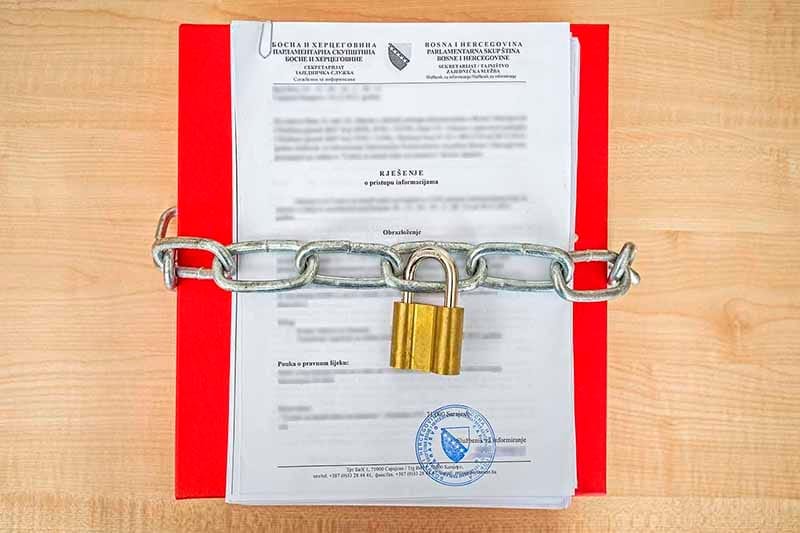
In mid-March 2026, the Court of Bosnia and Herzegovina (BiH) ruled that the BiH Presidency violated investigative journalists’ right to access information of public interest by withholding receipts related to work meetings, lunches, and dinners funded with public money.
Over the past 15 years, the CIN has won 18 court decisions against BiH institutions for failing to disclose public information. The Presidency is the only body found on two separate occasions not to have acted in line with legal requirements.
As a result, it was instructed to reconsider CIN’s request for data and documentation on representational spending. Nevertheless, despite the court’s findings, the Presidency reaffirmed its original decision, asserting it had already fulfilled the request.

Presidency of BiH tight-lipped over spending
In 2024, the CIN launched an investigation into representational spending by public institutions. The inquiry revealed that, from early 2020 to the end of 2024, the Presidency of Bosnia and Herzegovina spent BAM 931,088 in public funds on work-related meetings, lunches, and dinners.
Following this, CIN requested not only summary expenditure data but also detailed access to supporting documents such as invoices and receipts, including the right to photograph or photocopy them. While the Secretariat of the Presidency provided general spending information, it denied access to the actual documents. It justified the refusal by citing the large volume of records involved, claiming their retrieval would impose excessive administrative strain, and further accused CIN of misusing its right to information access.
CIN then filed an appeal with the Appeals Council under the Council of Ministers of BiH. Instead of objectively reviewing the Secretariat’s actions, the Council overstepped its authority by considering matters not included in the original appeal. Although it ruled that journalists could view the documents, it prohibited copying or photographing them, a decision that ultimately weakened transparency standards within the institution.
“The Appeals Council overstepped its authority (…) by modifying the initial decision to the detriment of the appellant, an action it is not allowed to take,” said Ena Kljajić Grgić, head of the Legal Aid Centre at Transparency International BiH (TIBiH), who supported CIN throughout the legal process.
In mid-2025, a CIN journalist was given access to only a small portion of invoices, selected at the sole discretion of staff from the Presidency of Bosnia and Herzegovina. During the review, officials claimed they had shared all information they could gather at the time, considering the institution’s operational limitations and the Appeals Council’s prior ruling. For instance, out of BAM 266,702 spent in 2023, documentation was provided for just about BAM 10,000.
With most of the spending records still withheld from public view, CIN took legal action before the Court of BiH, asserting that citizens have a right to know how hundreds of thousands of marks are being used by members of the Presidency, their advisors, cabinet heads, and the institution’s Secretary General.
In March 2026, the Court of BiH ruled in favor of the investigative journalists.
“Denying photocopies of invoices and receipts constitutes an infringement on the right to access information, which forms part of freedom of expression,” the court stated. It also noted that the defendant failed to justify why full refusal was necessary and did not explore granting partial access while safeguarding sensitive details.
Kljajić Grgić emphasized the significance of the court’s ruling, noting that it confirmed journalists did not misuse their right to access information as previously alleged by the Presidency of Bosnia and Herzegovina, and highlighted the Appeals Council’s failure to properly carry out its responsibilities during the appeal process.
The Court of BiH instructed the Presidency to re-examine the information request in line with legal requirements. Yet, in May 2026, the Presidency issued a new response, asserting that CIN had already received the information it sought.
“Continuing to withhold public data despite a court decision supporting transparency is troubling and poses a serious concern,” said Aladin Abdagić, Editor-in-Chief at CIN. “This is especially critical considering the Presidency is one of the country’s key institutions and has now repeatedly defied transparency rulings. It’s crucial to understand why the Presidency remains so determined to keep information hidden,” he added.
CIN has since initiated legal proceedings against the Appeals Council within the Council of Ministers of BiH, challenging the Presidency’s actions. The dispute dates back to September 2017, when journalists first requested details on the individual earnings of the three Presidency members. The Presidency’s Secretariat denied the request, arguing that disclosure might lead to harm.
CIN appealed, but the Appeals Council dismissed the appeal. Ultimately, the Court of Bosnia and Herzegovina concluded the case in favor of the journalists, determining that the Appeals Council had not provided adequate justification for rejecting their request and that its decision violated established administrative procedures.
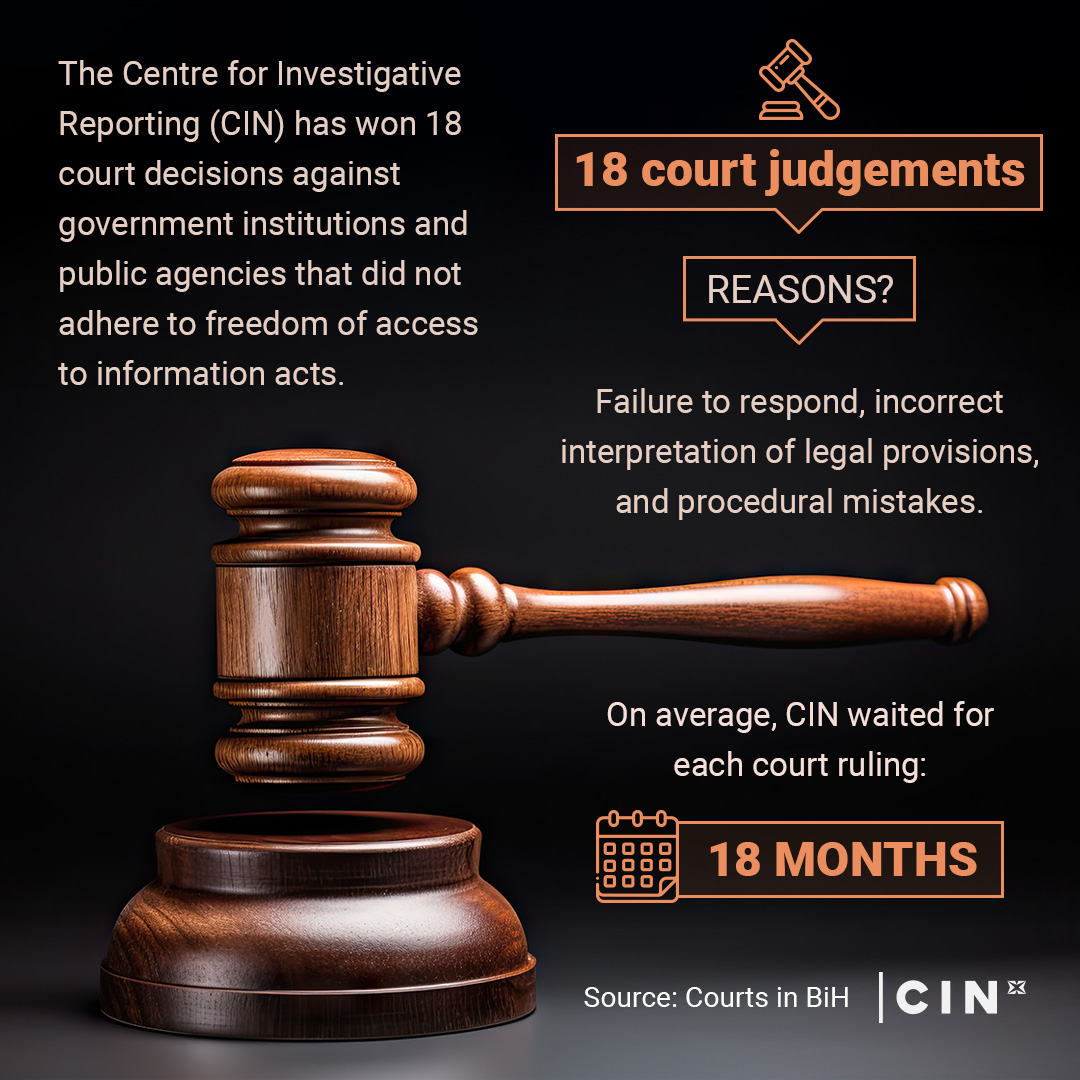
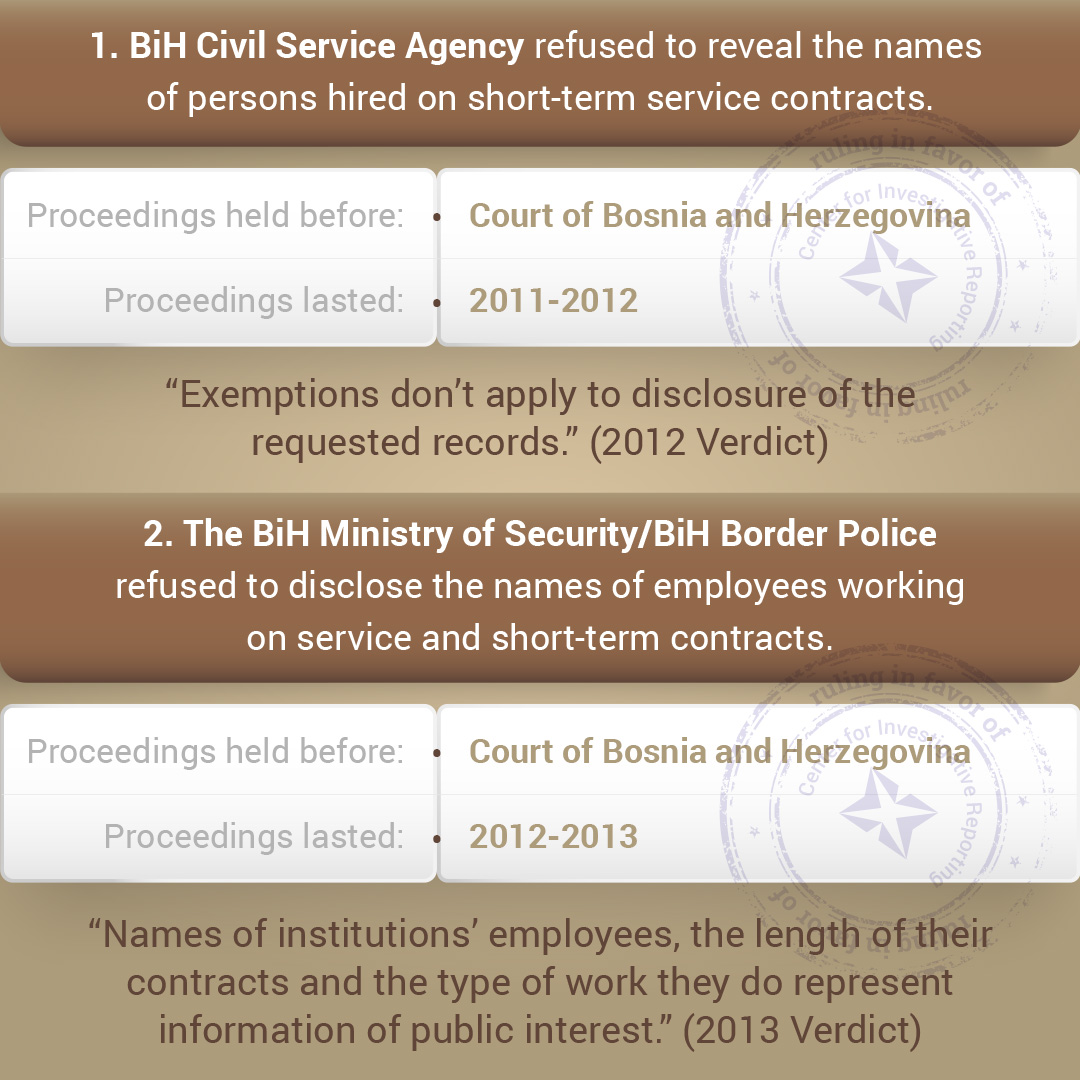
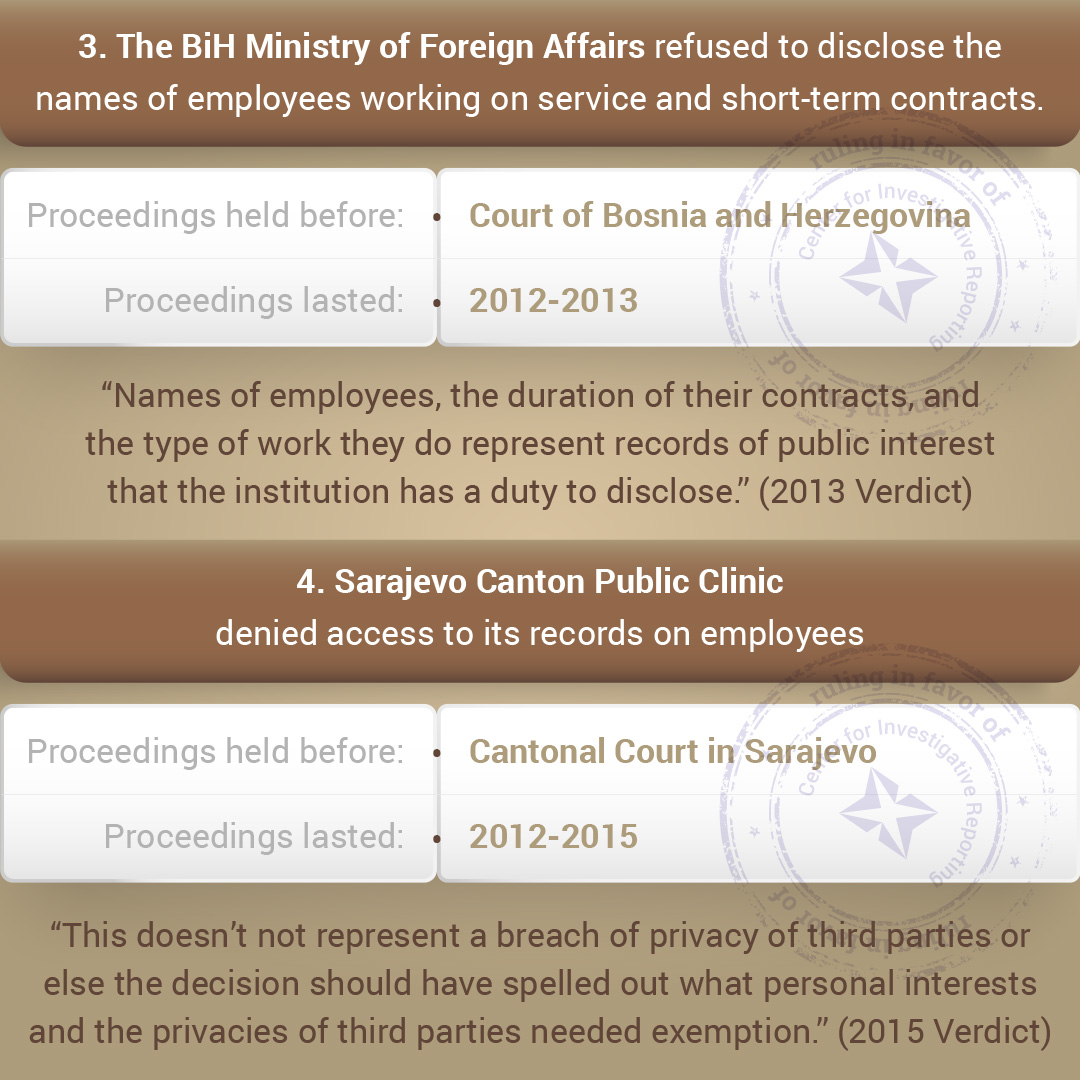
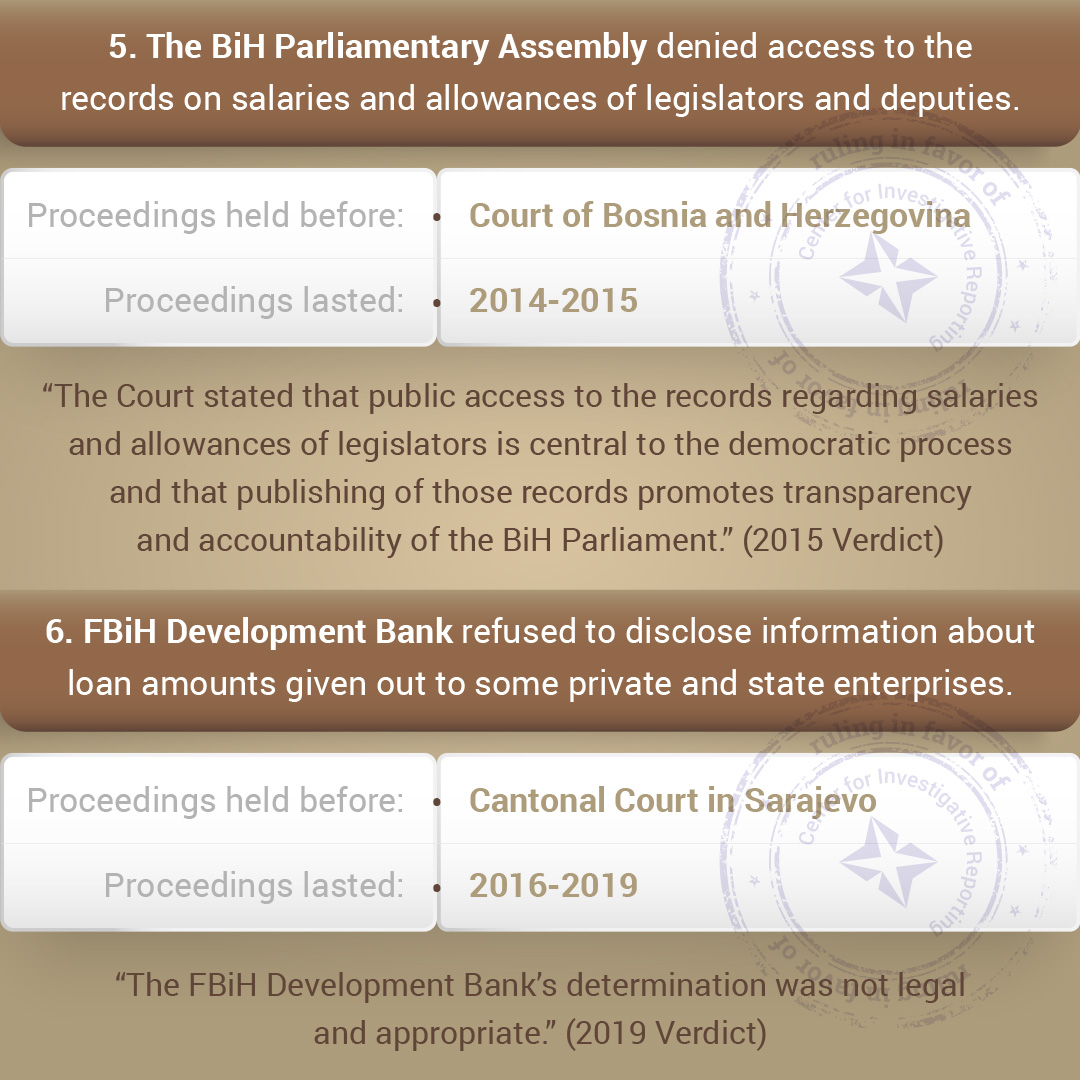
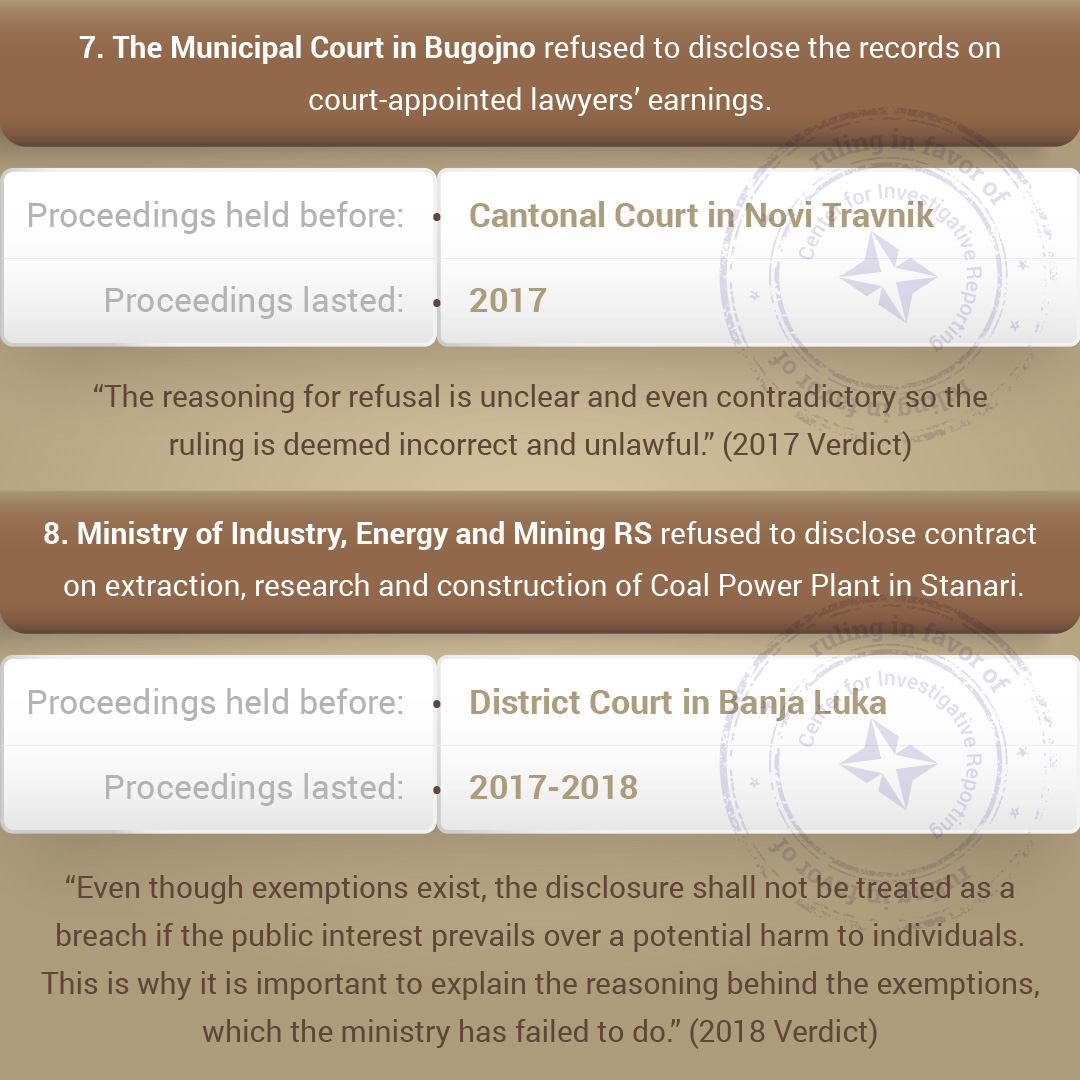
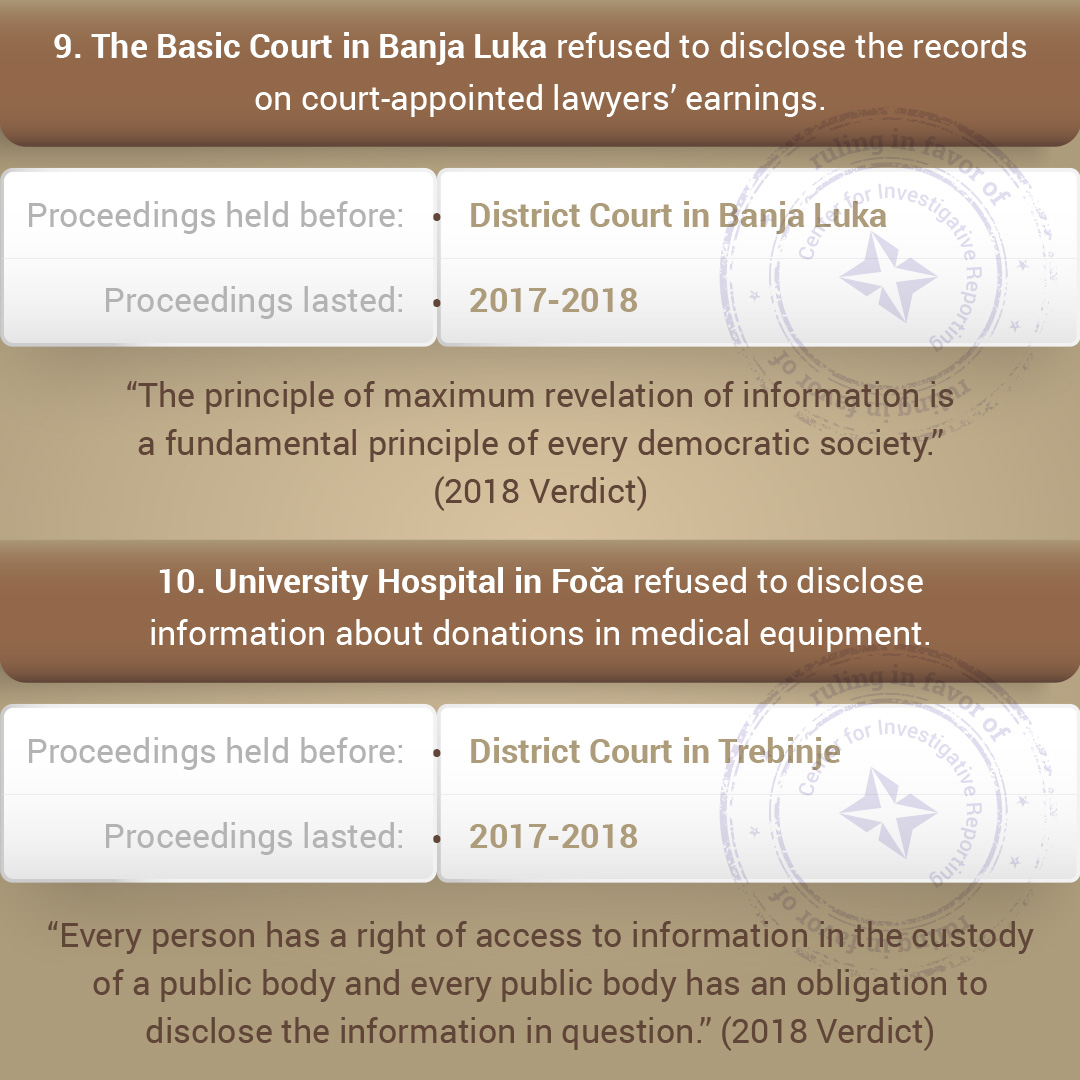
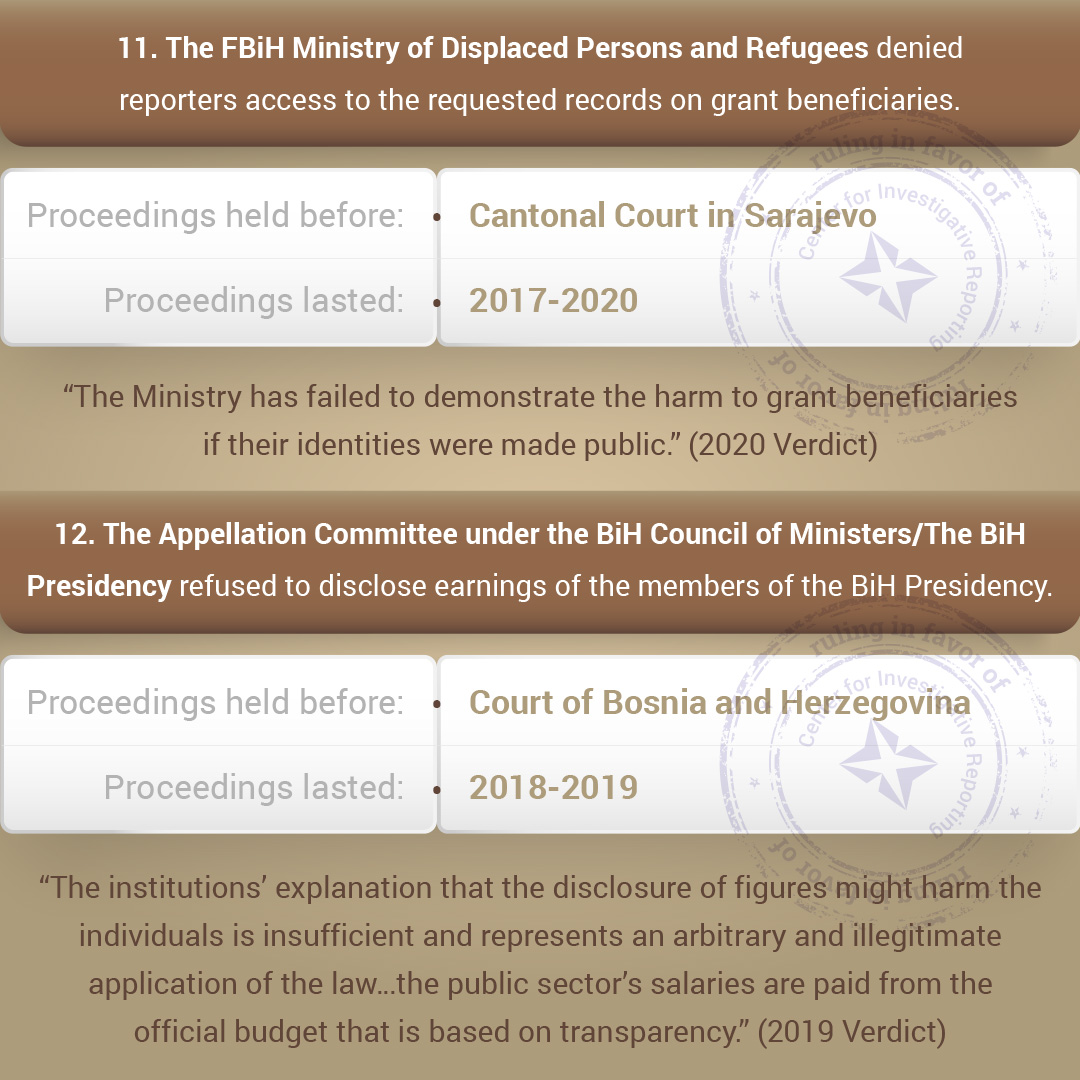
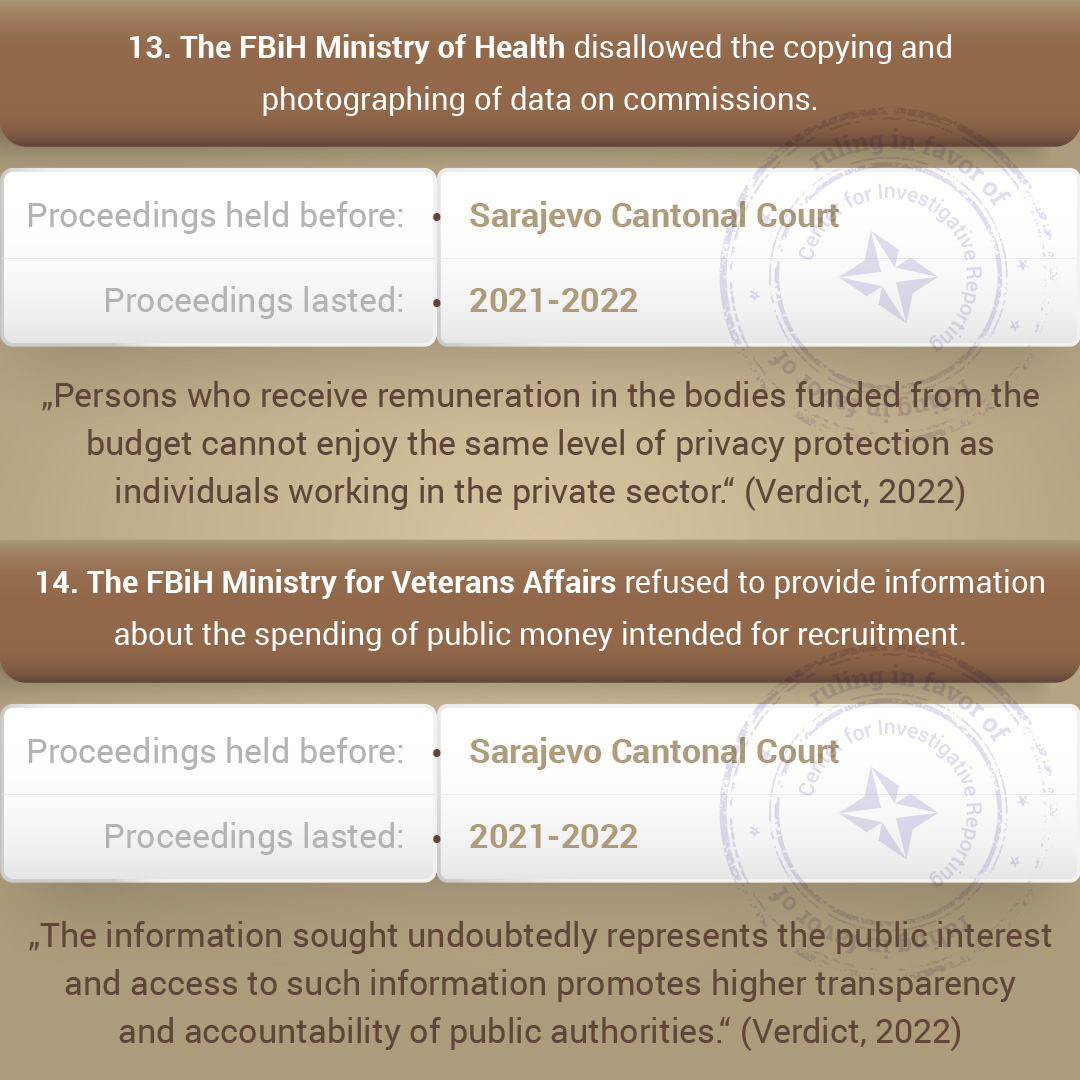
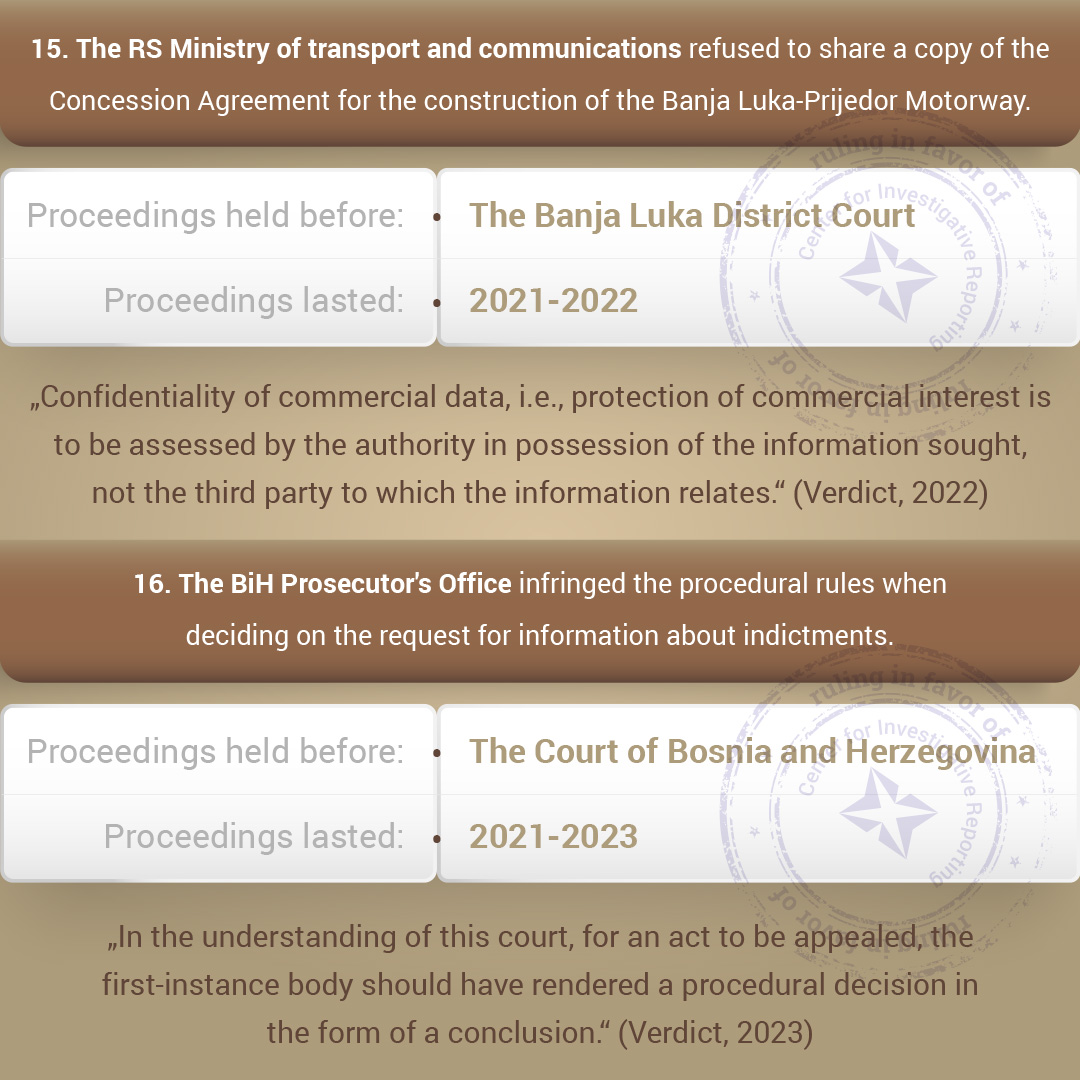
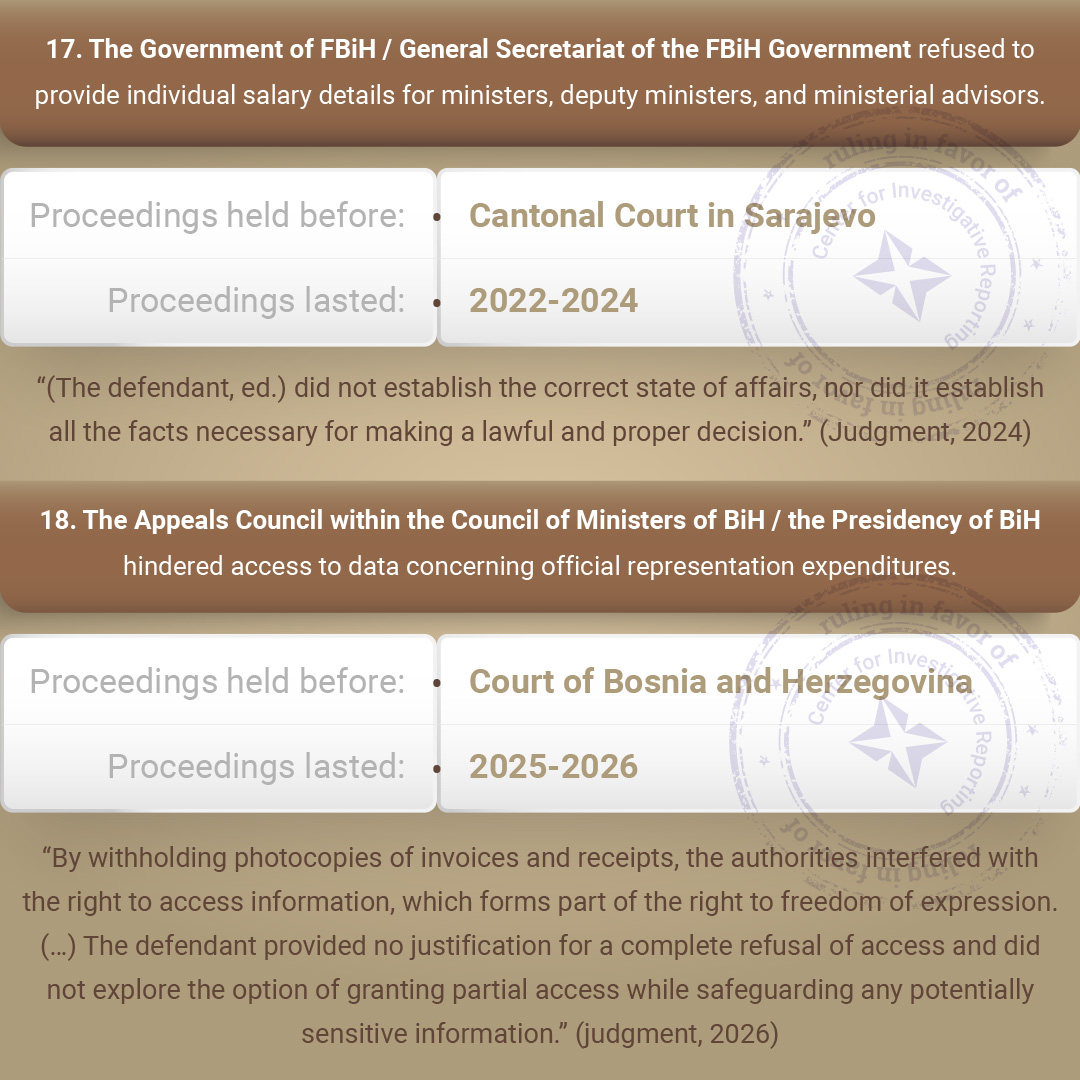
Beyond the Appeals Council, CIN has previously initiated legal action against various institutions that denied access to public information, including the Civil Service Agency of BiH, the Ministry of Security, the Ministry of Foreign Affairs, the Ministry of Industry, Energy and Mining of Republika Srpska, the Sarajevo Canton Health Centre, the District Court in Banja Luka, and others.
“CIN’s commitment to upholding the BiH Freedom of Access to Information Act encourages investigative journalists across the country to stand firm in asserting their right to information and to resist being portrayed as abusers simply for carrying out their professional duties,” says Kljajić Grgić.
The power of public information
In September 2025, CIN released an investigative report titled “Official Perks: Lavish Lunches, Shameless Bills,” relying primarily on data obtained through the Freedom of Access to Information Act from institutions at the BiH state level.
The findings covered nine state-level ministries, the General Secretariat, and the Office of the Chair of the Council of Ministers, which collectively spent 7.14 million BAM on representation costs between 2018 and 2024. The Presidency of BiH was not included in the analysis, as it denied access to the requested records.
By reviewing invoices, CIN journalists found that a considerable share of these expenses went toward alcohol purchases in cafes and restaurants, both within Bosnia and Herzegovina and overseas, frequently categorised as official working meals.
The institutions provide little detail on the objectives or results of such meetings, and internal oversight mechanisms were generally inadequate. As a result, detailed examination of expense claims is largely left to auditors from the Audit Office of the Institutions of BiH. Even when audits uncover problems, institutions often fail to act on the recommendations provided.
Dženana Burek, Executive Director of the Press and Online Media Council in Bosnia and Herzegovina, emphasizes that enforcing the Freedom of Access to Information Act is essential for a functioning democracy, as it ensures public institutions remain accountable.
She explains that the Freedom of Access to Information Act allows journalists to examine areas such as public spending, hiring procedures, procurement processes, political decisions, potential misuse of authority, and conflicts of interest. “When this law isn’t consistently applied, public oversight of government is severely limited,” Burek stated. She noted that court rulings highlighting institutional violations serve as ongoing reminders of legal breaches, which can damage an institution’s reputation, intensify public scrutiny, and ultimately push authorities to respond more seriously to media inquiries.
Ena Kljajić Grgić from Transparency International BiH points out that, in practice, institutions often remain opaque even after repeated legal actions. “Our experience shows a recurring pattern of resistance to providing information, even when previous rulings have been in our favor,” she said.
Such resistance leads to new administrative disputes, dragging out the process and raising the cost of accessing public data.
Between 2009 and 2025, the Legal Aid Centre of Transparency International BiH documented 286 final and pending court decisions at all levels of government in access-to-information cases. Of these, 234 rulings supported the requests, including those granted through extraordinary legal review, while 52 were dismissed.