

For years, the Sarajevo Canton Public Utility Company (KJKP) GRAS has employed drivers who obtained their jobs using forged qualifications. These individuals submitted fake diplomas from secondary schools specializing in transport and traffic when they applied for jobs.
Journalists from the Centre for Investigative Reporting (CIN) have learned that six of these drivers are still employed by the company even after receiving final court convictions for possessing forged documents, and continue to operate GRAS vehicles.
Besides these six individuals, three additional employees were also found guilty. One of them continues to work at GRAS as a porter, while the other two are no longer with the company. In four instances, legal proceedings were dropped due to expired statutes of limitations or because no criminal act was identified. In one case, an appeal has been lodged against the conviction, and another case is still awaiting resolution.
According to the Sarajevo Municipal Court, the convicted individuals acquired falsified diplomas from secondary transport and traffic schools between 1997 and 2015, which they submitted during job applications and when signing employment contracts with the cantonal public enterprise. The Sarajevo Canton Office for the Fight Against Corruption established that 15 GRAS employees had, at various points, used fraudulent credentials. For years, these individuals held responsibilities directly tied to passenger safety, as well as the mechanical condition and technical reliability of the company’s vehicles.
All GRAS employees who were convicted, mostly bus drivers, were given suspended prison sentences, and their secondary school diplomas from transport and traffic vocational schools were permanently revoked.
According to GRAS’s Employment Regulations, the driver position requires a Level III vocational qualification, which corresponds to finishing a three-year secondary vocational programme in the relevant field.
Zlatko Kovačević, a technical sciences professor specialising in road transport, told CIN reporters that individuals without formal qualifications could not have been legally hired by the cantonal public transport company.
“In that respect, the drivers were, so to speak, encouraged to produce (a diploma – author’s note) as it is a prerequisite for employment as a professional driver – they must hold both the relevant qualification and the vocational title of ‘motor vehicle driver’,” Kovačević explained.
Senad Mujagić has been the director of GRAS since the initial convictions were issued in 2021. After a tram derailment on 16 February 2026 that resulted in one fatality and left another person seriously injured, Mujagić submitted his resignation. Mujagić continues to hold the position of GRAS director.
CIN journalists made multiple attempts to reach Mujagić and other GRAS staff handling media inquiries by phone and message but received no response. Journalists also visited the company’s headquarters in an attempt to speak with the convicted employees, but to no avail.
GRAS has faced judicial scrutiny not only for hiring staff with falsified credentials but also in connection with the deadly incident in February 2026. A tram derailed near the junction outside the National Museum of Bosnia and Herzegovina, resulting in the death of a young man. A teenage girl was also seriously injured and later required the amputation of one leg.
The investigation into the events leading up to the accident is still underway, as prosecutors from the Sarajevo Canton Prosecutor’s Office continue collecting evidence to determine the full sequence of events that caused the tragedy.
Nihad Uk, Sarajevo Canton Prime Minister, and Senad Mujagić, director of GRAS, have tendered their resignations. In reply to a query from CIN, the Sarajevo Canton Prosecutor’s Office stated that it has gathered substantial documentary material, questioned numerous witnesses, and ordered several forensic medical assessments.
“The investigation is proceeding intensively and is being treated as the highest priority by this office,” the Prosecutor’s Office said in its written statement
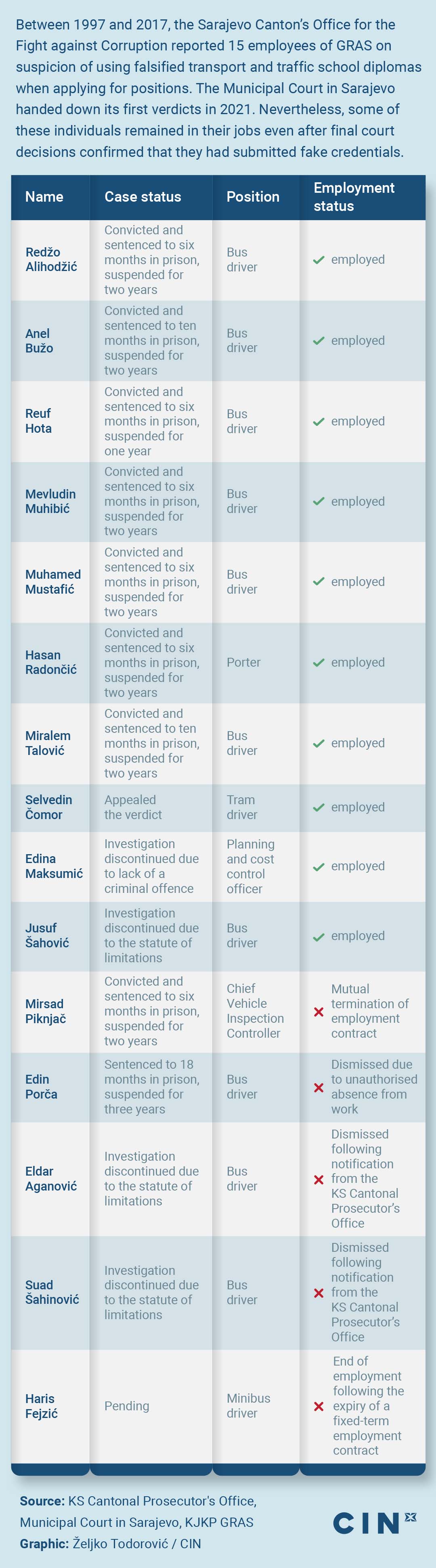

Diplomas revoked, jobs retained
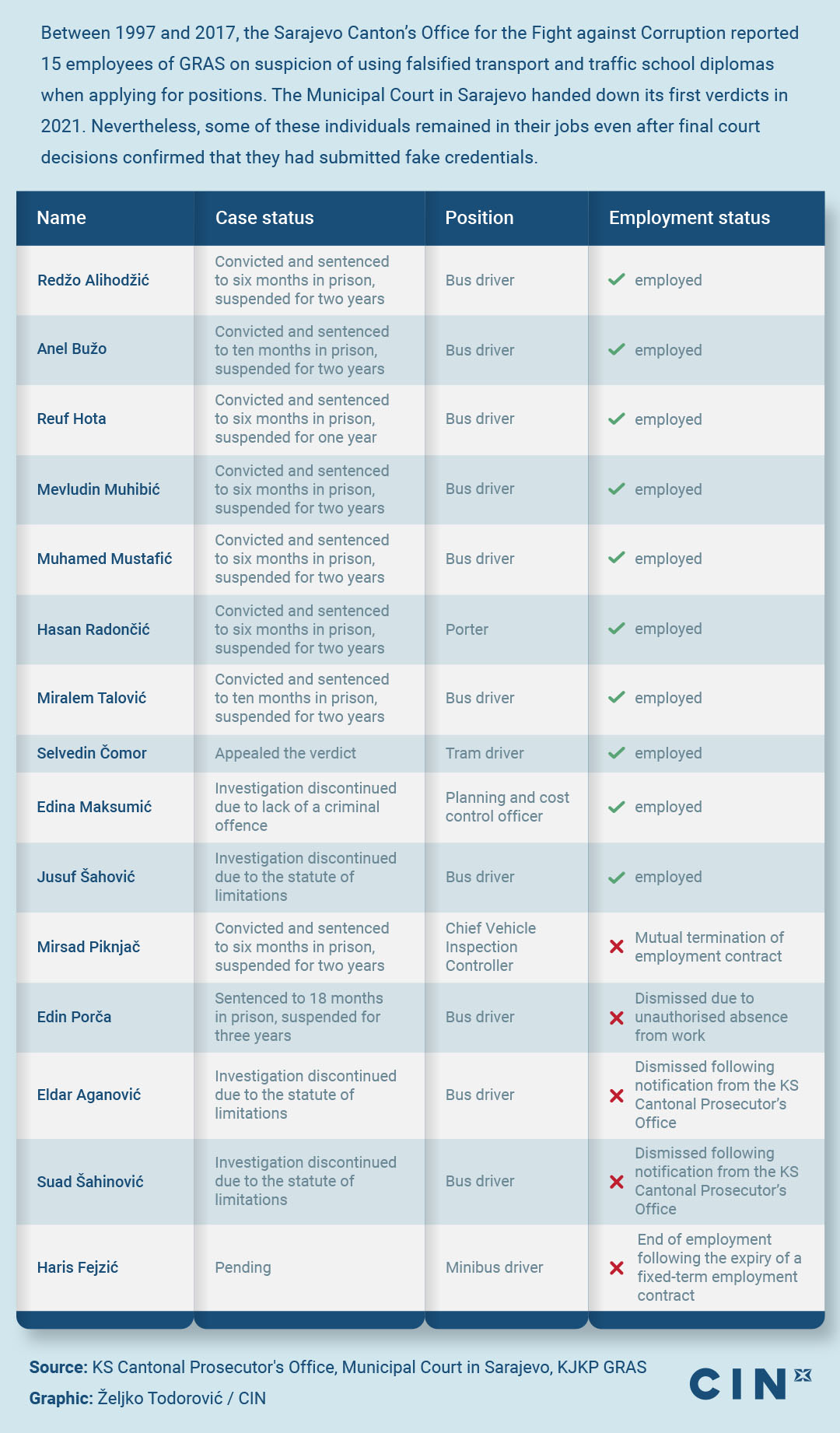
Reuf Hota, Miralem Talović, Redžo Alihodžić, Anel Bužo, Mevludin Muhibić, and Muhamed Mustafić, drivers of trolleybuses and buses, remain employed by GRAS even though they have been definitively convicted of using falsified diplomas to gain their positions. The same is true for Hasan Radončić, who continues to work at the company as a porter. Tram driver Selvedin Čomor has filed an appeal against his conviction, meaning the ruling against him is not yet final.
These employees presented counterfeit secondary school certificates said to originate from various places across Bosnia and Herzegovina. Four of the convicted individuals used diplomas allegedly issued by the Mixed Secondary School of Transport in Sarajevo.
For instance, Alihodžić obtained a position as a bus driver in early 2017 by submitting a certified copy of a diploma that supposedly dated back to 2004, claiming it had been issued by that Sarajevo school. The investigation later confirmed that he had never actually been enrolled at the school, despite the diploma serving as the crucial document that allowed him to obtain his job.
Meanwhile, several similar cases were also processed by the courts, all ending in convictions. Bus drivers Muhibić, Mustafić, and Radončić, along with trolleybus driver Bužo, received suspended prison sentences and were ordered to surrender their counterfeit diplomas from the Sarajevo school, documents they had allegedly acquired between 2002 and 2015. Their suspended prison sentences ranged from six to ten months.
Hota, a bus driver for GRAS, was one of the first employees convicted. In September 2021, he was sentenced to six months in prison, suspended for one year. The court determined that during the 2017 hiring process, he submitted falsified school certificates allegedly issued by the Mixed Secondary School of Transport in Tuzla, despite never having attended or graduated from that institution.
His colleague, Talović, engaged in a similar act. When applying for his position, Talović presented a driver’s diploma supposedly granted in 2004 by the Mixed Secondary School in Brijesnica Velika, near Doboj-Istok. Subsequent legal proceedings confirmed the diploma was counterfeit and that Talović had used the false document with full awareness. In November 2021, he was given a ten-month prison sentence, suspended for two years.
The legal proceedings involving tram driver Selvedin Čomor remain ongoing, as he has appealed the suspended sentence. The Sarajevo Canton Prosecutor’s Office alleges that when Čomor applied for a job at GRAS in 2017, he submitted a photocopy of a diploma supposedly issued by the Mixed Secondary School of Transport in Sarajevo in July 1997. The charges indicate that he never attended or graduated from that institution and that he used the same document during the renewal of his employment contract in both 2019 and 2020. He is still employed as a tram driver.
Zlatko Kovačević, a court-designated expert in road traffic, emphasized that professional training carries greater weight than merely possessing a driver’s license when it comes to safeguarding passengers.
“In terms of road transport safety, it’s crucial that drivers fully understand all legal regulations, have proper training in vehicle operation, and are aware of the correct procedures, and safety measures for any situation they might encounter,” Kovačević explained.
Dismissals and Statute-Barred Proceedings
Based on information collected by journalists, the Municipal Court in Sarajevo has also handed down convictions for Mirsad Piknjač and Edin Porča, neither of whom currently works for GRAS.
Piknjač began his career as a trolleybus driver in 2000. In 2008, he submitted what appeared to be a certified copy of a diploma from the Mixed Secondary School of Transport in Sarajevo, dated 2006, claiming it qualified him as a road traffic technician.
That credential allowed him, in 2019, to obtain a senior role in the public transport network – chief vehicle inspection controller.
In February 2024, he received a six-month prison sentence, suspended for two years, after being found guilty of repeatedly using the falsified document. His employment with GRAS, which had lasted 24 years, ended in May of that year through a mutual agreement.
Porča advanced within the GRAS system along a similar path, even though he did not possess the official qualifications normally required for such positions. He allegedly used a fake diploma from the Secondary School for Traffic and Communications in Sarajevo, dated 1998, to obtain a job as a motor vehicle driver. As a result, he received a one-and-a-half-year prison sentence, suspended for three years. Nonetheless, the company did not terminate his employment because of the forged document. According to GRAS, in a reply to journalists via email, he was let go due to unapproved absences from work.
Separately, investigations were conducted into Eldar Aganović, Jusuf Šahović, and Suad Šahinović over suspected possession of falsified diplomas, but legal proceedings were dropped due to the expiration of the statute of limitations. In Edina Maksumić’s case, authorities determined that no criminal act had occurred.
She remains employed at GRAS as a planning and cost control officer, and Šahović continues to work as a bus driver. Aganović and Šahinović, while not convicted, were dismissed after GRAS received notifications from the Sarajevo Canton Prosecutor’s Office.