

The Basic Court in Bijeljina delivered a verdict in a domestic violence case, even though not all members of the judicial panel had read the indictment or familiarised themselves with the case file.
The panel imposed a suspended sentence that the defendant had negotiated with the prosecution through a plea agreement, even though a custodial sentence should have been handed down, as the offence involved physical violence committed in the presence of a child.
Over the handling of the case, Bijeljina judges Aleksandar Despenić, Dragoljub Đurić, and Marinko Sladić, together with Bojana Lazarević, a prosecutor at the Bijeljina District Public Prosecutor’s Office who signed the plea agreement with the defendant, were brought before a disciplinary commission of the High Judicial and Prosecutorial Council (HJPC).
All four were fined for professional negligence. The judges received a 10 per cent salary reduction for six months, while the prosecutor’s salary was cut by 40 per cent for three months.
Unlike the prosecutor, who accepted responsibility, the judges appealed the decision. In their defence, they argued that the statute of limitations for initiating disciplinary proceedings had expired, that no appeal had been filed against the original verdict, and that the mistake had not been intentional. One of the judges said he had neither read the indictment nor reviewed the case file.
He said he had been informed of the hearing on the acceptance of the plea agreement shortly before it began. According to him, the presiding judge told the panel that the legal conditions for accepting the agreement had been met and that there was no need to read the indictment. He also noted that no record of the panel’s deliberations and vote had been prepared for all members of the judicial panel to sign.
The disciplinary commission rejected their appeals. The proceedings found that the officials had acted with conscious negligence and had failed to follow the relevant legal provisions. The ruling stated that their conduct could lead the public to conclude that the judiciary is incompetent and selective in its application of the law.
Prosecutor Lazarević and the presiding judge Despenić declined to comment publicly on the case, while judges Đurić and Sladić did not respond to questions from CIN reporters.
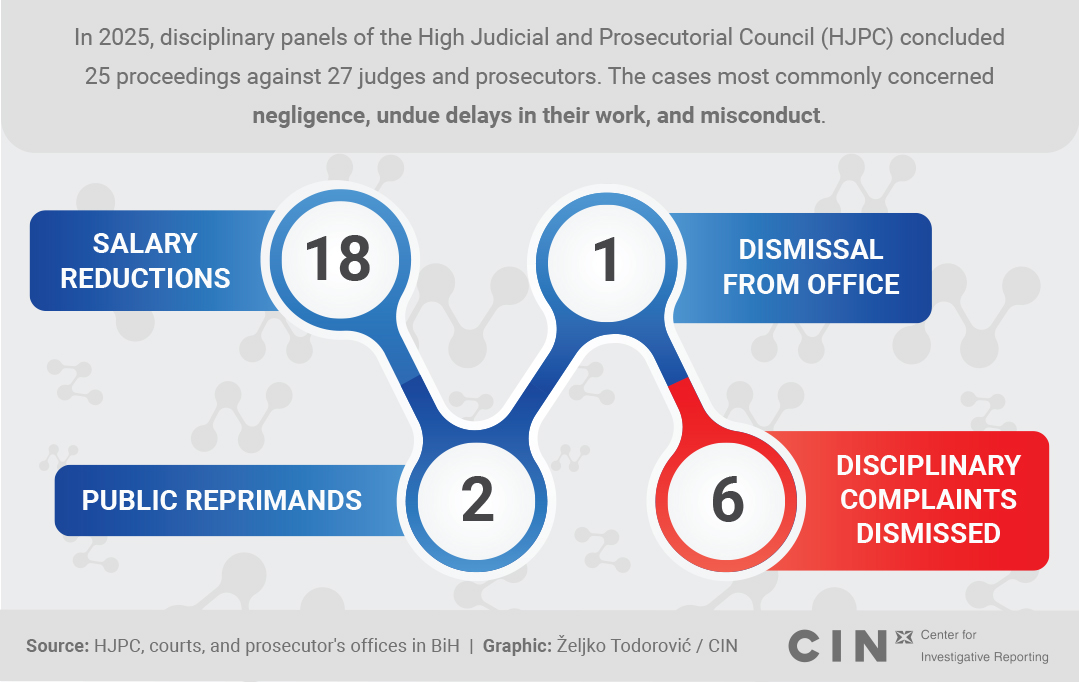
According to data published by the HJPC, disciplinary proceedings against 27 judges and prosecutors in Bosnia and Herzegovina were concluded in 2025. Eighteen received financial penalties, six were cleared of responsibility, two were issued public warnings, and one was dismissed from office.
The dismissed official was Ekrem Šarić, a judge at the Municipal Court in Velika Kladuša. According to the disciplinary ruling, he issued unlawful decisions and committed other professional breaches. He declined to comment on the case.

Criminal Proceedings Alongside Disciplinary Action
The Office of the Disciplinary Counsel (ODC), which initiates proceedings against judges and prosecutors, also asked the disciplinary commission to dismiss Katica Jozak‑Mađar, the former president of the Cantonal Court in Novi Travnik.
The disciplinary proceedings found that Jozak-Mađar had committed several breaches: she appointed an employee who did not meet the required qualifications as head of information and communications technology; at her instruction, the case-management system was adjusted in 14 cases so that they would be assigned to particular judges; she also recorded 16 cases as completed even though she had not drafted the rulings.
In addition, she was found to have behaved inappropriately. In May 2023, during the selection of a new president of the Cantonal Court in Novi Travnik, Jozak-Mađar reacted angrily at the HJPC premises after learning she had not been reappointed. In the presence of several witnesses, she shouted that a mistake had been made, that she was “the best court president in the country” and that council members had been “bought”. She refused to leave the building when asked and was eventually escorted out by a judicial police officer.
Jozak-Mađar denied responsibility. In her defence, she argued that she had committed no offence, that she had successfully managed the institution, and that the evidence against her had not been collected lawfully. She also claimed that any irregularities in the CMS, automated case-allocation system, were likely the result of technical errors or mistakes by those operating it, and that she had not wrongly recorded cases as completed.
Her appeal was rejected, but the disciplinary commission also declined the ODC’s request for her dismissal. Instead, she received a financial penalty: a 50 per cent salary reduction for six months.
In a conversation with a CIN reporter, Jozak-Mađar said she could not comment publicly, given her current situation. She is currently suspended. In October 2024, while the disciplinary proceedings were still ongoing, the Cantonal Prosecutor’s Office of the Zenica‑Doboj Canton filed an indictment against her on suspicion of unlawfully employing three civil servants and staff members at the Cantonal Court in Novi Travnik, which she led for nearly two decades. The criminal trial has not yet begun.
Alongside Jozak-Mađar, who has now faced disciplinary proceedings for the second time, six other judges and prosecutors appeared before the disciplinary commission in 2025 for a second or third time on similar grounds.


Previous disciplinary proceedings are considered an aggravating factor when sanctions are imposed, while mitigating circumstances may include cooperation with the commission and the ODC during proceedings, heavy workloads, working conditions, and similar factors.
Under the HJPC’s Rules of Procedure, judges and prosecutors who receive disciplinary sanctions are barred from applying for vacant positions within judicial institutions for between one and eight years, depending on the severity of the penalty.
However, three judges avoided that restriction because disciplinary proceedings were initiated only after they had already been promoted.
They are Jasmina Lipovača, a judge at the Cantonal Court in Bihać, Mirjana Kevo, a judge at the Cantonal Court in Mostar, and Denis Kurtović, a judge at the Court of Bosnia and Herzegovina. Their disciplinary cases related to breaches committed while they were serving in municipal courts.
While working at the Municipal Court in Bihać, Lipovača allowed the enforcement of a six-month prison sentence against Evad Rahmanović, who was convicted of theft from a house in Bihać, to expire under the statute of limitations. As a judge at the Municipal Court in Mostar, Kevo delayed drafting a decision in a case involving interim measures and failed to forward the case for appellate review. Meanwhile, Kurtović, while serving at the Municipal Court in Sarajevo, delayed drafting rulings in 27 cases by several months.
Lipovača cited a heavy workload and the statute of limitations for initiating disciplinary proceedings in her defence. Kevo argued that her actions had not undermined public confidence in the judiciary and had caused no harm to the parties involved. Kurtović, however, immediately accepted responsibility.
Lipovača received a 10 per cent salary reduction for five months, Kevo was issued a public warning, and Kurtović received a 20 per cent salary cut for three months.
In a written response to CIN, Kurtović said he had paid the penalty and explained that during the relevant period, he had been performing additional duties as head of the criminal department and deputy president of the court. Those responsibilities, he said, had contributed to the delays. He also noted that no harmful consequences had occurred because the rulings were ultimately delivered, and added that he had still met his performance quota with the highest evaluation.
Judge Kevo declined to comment, while Lipovača did not respond to reporters’ enquiries.
Cleared of Responsibility
Among the cases concluded last year were six in which the disciplinary commission determined that no misconduct had occurred as alleged by the Office of the Disciplinary Counsel. One of them involved Ćazim Serhatlić, a prosecutor at the Cantonal Prosecutor’s Office of Tuzla Canton, who had been reported by Transparency International Bosnia and Herzegovina.
The complaint followed Serhatlić’s decision to discontinue and not pursue a criminal investigation requested by the organisation over public procurement at the Kreka Mines. The organisation said it was informed of the decision only a year later, after sending numerous letters and enquiries.
Damjan Ožegović of Transparency International BiH said the organisation was dissatisfied with the outcome and believes the prosecutor committed a disciplinary breach. He noted that failing to deliver an order not to pursue an investigation prevents the complainant from filing an appeal.
“What is additionally problematic is that we learned about the outcome of this disciplinary case from the media, and the decision itself has still not been delivered to us,” Ožegović said.
In the same proceedings, Serhatlić was also accused of inappropriate communication with Admir Suljagić, who had been reported for a criminal offence and was then head of the HJPC secretariat. Through the WhatsApp messaging application and the LinkedIn social network, Serhatlić informed Suljagić that he would be summoned for questioning by the State Investigation and Protection Agency (SIPA), stating that he did not need a lawyer because he would be questioned as a witness, adding, “about what we discussed”.
However, the disciplinary commission concluded that the prosecutor had acted appropriately. He had exercised his discretionary authority in granting Suljagić the status of a witness. The commission also concluded that the ODC had failed to prove how the prosecutor’s conduct had undermined the reputation of the prosecutorial office.
“When someone is a witness, especially during the investigative stage, it is the prosecutor’s right and duty to communicate with that witness in any way necessary,” Serhatlić told CIN. “Today, when we have thousands of cases, we simply don’t have time to send formal summonses, schedule hearings, and wait for someone to respond. Sometimes it is more practical to make contact by phone.”
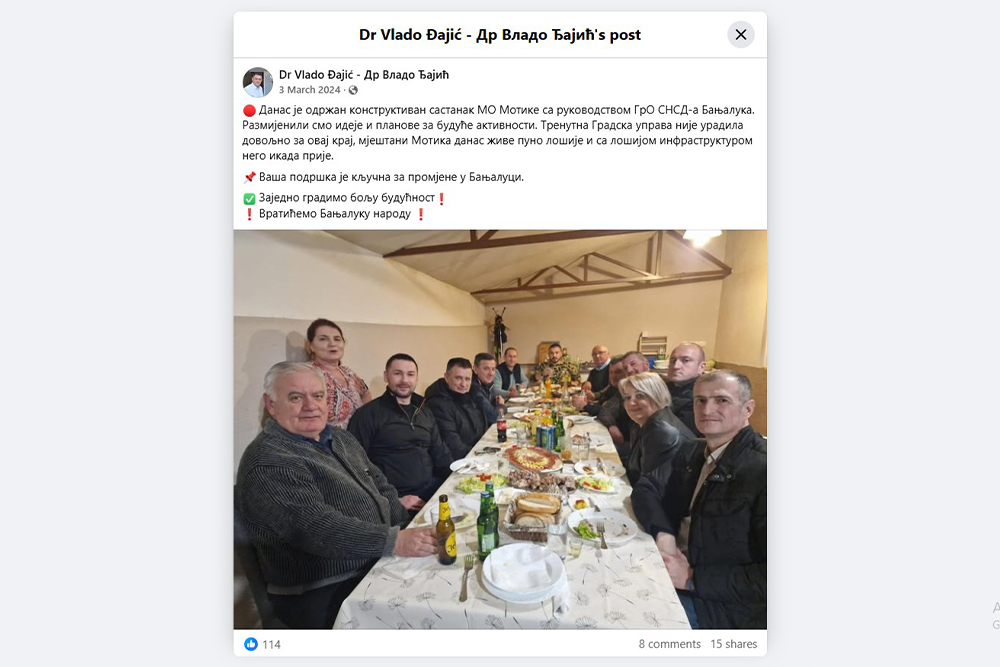
The disciplinary commission also concluded that the ODC had failed to prove that public confidence in the judiciary had been undermined in the case of Spasen Keleman, a judge at the Basic Court in Banja Luka.
Proceedings were launched after Vlado Đajić, a member of parliament in the National Assembly of Republika Srpska from the Alliance of Independent Social Democrats (SNSD), posted a photograph on social media in March 2024 showing Keleman with several other individuals. The post described the gathering as a party meeting. The news about the image spread quickly, as Keleman had previously acquitted the party’s leader, Milorad Dodik, in a criminal case.
In the disciplinary proceedings, the judge said he had briefly stopped by for food and drinks at the invitation of his kum, who lives next door to him, and that he had not been told what the event was or who would attend. He said there were many guests present, including Đajić, whom he knew as a medical expert witness and a doctor who had treated him. The photograph, he said, had been taken at the request of a former trainee and was later misused for electoral purposes without his knowledge.
The commission concluded that judges are not obliged to leave informal gatherings if someone who is a member of a political party joins the event, provided that the gathering is not politically motivated or conducted in a political context.
In addition to financial penalties, warnings, and dismissal, judges and prosecutors may also receive written warnings that are not publicly disclosed, be transferred to a lower position or to another institution, or be required to undergo additional training.
Data on disciplinary sanctions imposed in 2025 have been added to the existing database “Disciplinary Sanctions Against Judges and Prosecutors”.


This database contains information on 334 disciplinary decisions issued between 2010 and the end of 2025 against judges, prosecutors, and professional associates accused of violating the Law on the HJPC and the ethical codes governing judicial and prosecutorial conduct. The database contains the names of judges, prosecutors, and expert associates, the names of the institutions where they worked at that time, a description of the offense, and the final decision.
Citizens cannot find complete data on disciplinary sanctions anywhere, which is why this database is unique.