Nenad Nešić, president of the Democratic People’s Alliance (DNS) and former Minister of Security of Bosnia and Herzegovina, spent July 2025 at his 346 m² luxury penthouse near the beach in Tivat, Montenegro.
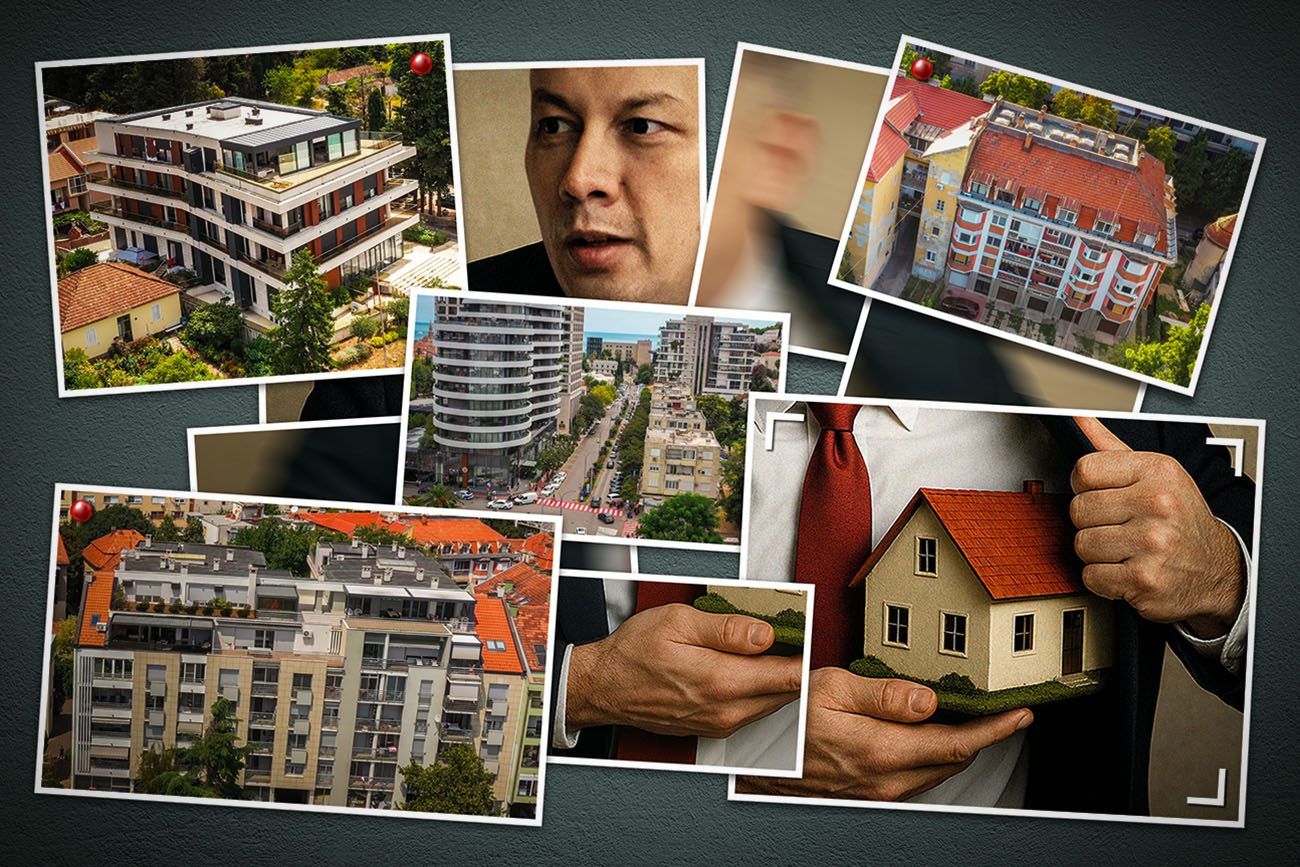
Nešić paid over 625,000 BAM in cash for the penthouse and two garage spaces in July 2020. Over the following two years, he and his wife Maja acquired an additional flat and garage in Budva, Montenegro, as well as part of a house with a yard in Sarajevo, for nearly 450,000 BAM.
The Nešić couple also owns three flats, a garage in Novi Sad, Serbia, and a portion of a house with land in Istočno Sarajevo. Journalists from the Centre for Investigative Reporting (CIN) were unable to determine how the Nešić couple acquired the properties in Serbia, as the country’s land registries do not permit public access to documents detailing property acquisition. The current market value of these properties is at least 1.8 million BAM.
“I paid without taking a loan. Bought everything legally, from my income. I have a salary. Everything was paid properly through the bank where I receive my salary,” Nešić told N1 television in 2023. He refused to speak with CIN journalists.
“I have neither the will, nor the desire, nor the time,” he said.
Nešić invested at least one million BAM in real estate towards the end of his tenure and after resigning from his post as acting director of the public company JP Putevi Republike Srpske. His management of the company has been under investigation by the Prosecutor’s Office of Bosnia and Herzegovina for more than five years.
He is suspected of laundering money, accepting bribes, and abusing his position between 2016 and 2020, generating around one million BAM in financial gain.
“From the preliminary financial investigation report, it is possible to determine a discrepancy, that is, illegally acquired assets,” said Bojana Jolović, the prosecutor on the case, during one of the hearings on extending Nešić’s detention.
CIN journalists revealed that in his 2023 declaration of assets, submitted before taking office as Bosnia and Herzegovina’s Minister of Security, Nešić failed to declare six properties in Montenegro and Serbia. He resigned from the ministerial post after being placed in a six-month detention in 2024.
“I have never hidden anything,” Nešić told the Court of Bosnia and Herzegovina while requesting his release from custody. The investigation against him is ongoing, and no indictment has yet been filed.

From Inspector to Detention
Nešić began his career in 2007 as a law graduate working as a criminal investigator in Istočno Sarajevo. During this period, he was sentenced to two months in prison over a 2011 incident in Novi Sad, Serbia, involving obstruction of a police officer from the Serbian Ministry of Internal Affairs.
He did not stay long in law enforcement, turning instead to politics after joining the Democratic People’s Alliance (DNS) in 2014, a party he has led since 2020.
Just two years after joining, he secured a directorship. In mid-2016, he was appointed acting director of JP Putevi Republike Srpske.
In this role, Nešić signed multi-million BAM contracts with companies responsible for road maintenance across Republika Srpska (RS). During his term, nine firms held contracts with Putevi Republike Srpske. These four-year agreements were valued between 10 and 30 million BAM, depending on the length and sections of road covered. Only two company executives agreed to speak with CIN journalists.
“This covers maintenance for all 12 months, with five months legally defined as winter maintenance and the remaining seven months as summer maintenance,” Radenko Crnogorac, director of Prijedorputevi, told reporters.
For winter road maintenance, companies require thousands of tonnes of salt. Each year, winter service plans determine the amount of salt a company must procure in order to secure a contract.
“All the risk falls on the road maintenance companies. In a mild winter, leftover salt is carried over to the next season, where weather conditions can cause it to harden and lose volume. JP Putevi RS pays based on monthly usage, which means companies must purchase the salt ahead of the winter season and finance it themselves,” explains Jelenko Vasić, director of Zvornikputevi.
However, securing this salt was not always straightforward due to the limited number of suppliers. Companies previously sourced salt from the Banja Luka firm Bom-Impeks. CIN journalists were told that the company never had direct contracts with JP Putevi Republike Srpske, nor exclusive arrangements with any firm.
After Nešić assumed leadership of Putevi Republike Srpske, a new supplier entered the market: the Istočno Sarajevo-based company Legend, owned by his friend and party colleague Mladen Lučić.
“So, simply put, they appeared around 2017 and offered us the opportunity to purchase not just salt, but also road paint and other materials. In one conversation, they mentioned that they knew the director and could provide assistance if any problems arose,” Vasić said.
He added that Zvornikputevi agreed to buy around 2,000 to 2,500 tonnes of salt per year from Legend. Vasić and Crnogorac noted that other road maintenance companies did the same. The companies paid an average of about 180 BAM per tonne. Most of the salt was imported from Egypt, with a purchase price ranging between 69 and 85 BAM per tonne.
Vasić explained that the large difference between the purchase and sale price of the salt was not considered problematic, as the priority for companies was simply to secure a supplier to meet their contractual obligations with Putevi Republike Srpske.
“We simply have no choice. If you’re late or fail to buy salt, you risk losing the contract for regular maintenance,” Vasić added.
For Legend, the salt supply business quickly generated multi-million BAM profits. After its founding in 2015, the company initially reported no profit, but by the end of 2021, it had grown to over nine million BAM.

However, Lučić, the owner of Legend, was not the only one to profit from the salt procurement deals. An investigation by the Prosecutor’s Office of Bosnia and Herzegovina, ongoing since 2019, revealed that “Nešić demanded 10 % of the value of signed contracts to release payments to the road maintenance companies. Prosecutor Bojana Jolović stated in December 2024 that there is suspicion that owners of road maintenance companies were instructed by Nešić to purchase salt exclusively from Legend.
When CIN journalists asked whether he had been pressured to buy salt from this supplier, Crnogorac confirmed that verbal agreements and directives existed: “You always go with the flow,” he said.
Vasić noted that “it could be heard around” that companies were being conditioned: “Perhaps I’m one of the few directors who didn’t have good relations with him. Nešić didn’t come here himself, but he visited Romanijaputevi every week.”
During Nešić’s time as acting director, Romanijaputevi secured contracts for road maintenance in Republika Srpska worth 53.8 million BAM. As part of the investigation by the Prosecutor’s Office of Bosnia and Herzegovina, it was revealed that Mirko Pandurević, one of the owners and director of Romanijaputevi, was given an ultimatum to pay 10 % of the value of contracted jobs to Nešić.
“He was simply told that this was how it had to be for these deals; payments would be delayed otherwise. It can be concluded that Pandurević paid around 250,000 BAM annually,” Prosecutor Bojana Jolović said in December 2024, citing Pandurević’s testimony.

At one hearing, Jolović added that Nešić’s accomplice in this scheme was Mladen Lučić, owner of Legend. According to the prosecutor, the money from Romanijaputevi was routed through him to Nešić, via Esad and Senad Avdić—also suspects in the case—whose accounts were used to process payments for fictitious jobs. According to the Prosecutor’s Office of Bosnia and Herzegovina, Esad and Senad Avdić then handed the money to Lučić in cafés, restaurants, and petrol stations across Istočno Sarajevo.
This arrangement allowed Lučić to secure a monopoly on the industrial salt market for road maintenance, while, according to the prosecutors’ suspicions, Nešić gained millions in financial benefit.

Hidden Properties
Nešić’s wealth grew over the years, with the majority of his property acquisitions occurring towards the end of his tenure and after he stepped down as director of JP Putevi Republike Srpske in October 2020. He then continued his career as a member of the Parliament of Bosnia and Herzegovina, and later as Minister of Security.
Together with his wife Maja, Nešić owns 12 valuable properties across Bosnia and Herzegovina, Serbia, and Montenegro.
According to land registry (ZK) records from the Geodetic Authority of Republika Srpska, the Nešić couple was registered as property owners in Serbia between September 2020 and October 2024. However, the purchase prices of these properties are unknown, as the sales contracts are not publicly available.
None of the properties is mortgaged, and some were paid for in cash from Nešić’s and his wife’s bank accounts.
Despite this, in his 2023 asset declaration—submitted before taking office as a state minister—Nešić failed to report six properties in Serbia and Montenegro that he owns with his wife: four flats and two garages.
Under the Law on the Council of Ministers of BiH, ministerial candidates are required to provide details of their assets, previous positions, and any criminal proceedings. Providing false or incomplete information can result in criminal liability.


Among the undeclared properties is a luxury duplex penthouse in the centre of Novi Sad and a 27 m² garage. Snežana Pantelić, a licensed sales agent at the Belgrade-based real estate agency ZidArt, estimated the market value of these properties in 2025 at around 945,000 BAM.
He also failed to declare a 56 m² flat in a commercial building, which is estimated to be worth over 320,000 BAM.
During a visit to the property in August 2025, CIN journalists were met at the entrance by longtime concierge Mile Jeremija. He stated that the flat had never belonged to the Nešić couple.
“I can say this with full responsibility—I’ve been sitting here for 20 years, and that person has never set foot in here,” Jeremija said.
According to his records of property owners in the building, the flat is registered under the couple Snežana and Dragan Jurošević.
“Yes, that’s my flat,” Snežana Jurošević initially told a CIN reporter when asked about the property. However, after being shown the land registry documents, she changed her statement: “I plan to buy it from Nešić.”
Her husband, Dragan, declined to comment, telling journalists to contact Nešić directly.
While visiting Nešić’s properties, reporters also came across houses under construction, abandoned spaces, and flats that no one is using.
Nešić also failed to declare another 98 m² flat in the centre of Novi Sad, which agent Pantelić estimates to be worth over half a million BAM.
The Nešić couple was also registered as owners of a house under construction with a 497 m² yard in an attractive area of Petrovaradin, Novi Sad. During CIN’s investigation, a new owner was registered for this property: Serbian politician and longtime director of Srbijagas, Dušan Bajatović. According to estimates, the current value of the property exceeds one million BAM.
In addition to his properties in Serbia, Nešić did not declare a 74 m² flat and a garage space in Budva, Montenegro, which he and his wife purchased for 357,000 BAM from their bank accounts.
In his 2023 asset declaration, Nešić reported only a penthouse and two garages in Tivat, Montenegro, which he bought in July 2020. These consist of two 346 m² apartments located on the top floor of a newly built building with sea views, situated along the Adriatic Highway near the beach.
The properties were purchased from the Montenegrin company CONCORD MNE, and the sales contract specifies: “All payments to be made either in cash or to the account of an authorised person.”
“It was most likely cash by hand,” a source said. “At the time, in Montenegro, it was possible to make a cash payment with the obligation to later transfer the funds to the account of a legal entity,” Branka Vuksanović, the notary who certified the contract, told journalists.
Nešić arranged the purchase with Marjan Bevenja and Petar Milutinović, who managed the company CONCORD MNE. Both are currently on trial for serious criminal offences as members of the criminal organisation led by Miloš Medenica, the son of the former President of the Supreme Court of Montenegro.
The Special State Prosecutor’s Office of Montenegro has charged them, along with 15 co-defendants, with creating a criminal organisation, smuggling, bribery, abuse of office, and the illegal production, possession, and distribution of drugs.
“They were in a very friendly relationship,” the notary said, describing Bevenja and Milutinović’s ties to Nešić. Neither man responded to journalists’ requests for comment.
Nešić paid 625,000 BAM for these properties, most of it in cash, while for the remaining 175,000 BAM he exchanged another apartment he owns in Budva, according to contracts obtained by CIN with the help of colleagues from Montenegro’s Network for the Affirmation of the NGO Sector (MANS)
He authorised Bevenja to sell that flat and transfer the proceeds to CONCORD MNE, which Bevenja carried out. This concerns a 56 m² flat that Nešić had purchased seven years earlier for an even higher price.
The notary said she did not question the origin of Nešić’s funds, nor was she required to verify that the money had been transferred to the Montenegrin company.
“There are other authorities responsible for that. Believe me, I wouldn’t report anyone in the Balkans to the police as a spy. I would have to close my office,” Vuksanović said, adding that she had forwarded the sales contract to Montenegrin agencies responsible for preventing money laundering.
In the Sarajevo neighbourhood of Vraca, near the Memorial Park, Nešić purchased part of an unfinished 79 m² house and a 324 m² share of the yard in 2022 for 90,000 BAM. Together with his brother Predrag, he also owns a house with 45 dunums of land in the Toplik area of Istočno Sarajevo. These properties were declared in his 2023 asset declaration.

Nešić owns N-GROUP, a company trading in food, beverages, and tobacco, which posted a profit of just 420 BAM in 2023. During his tenure as director of Putevi Republike Srpske, he earned around 36,000 BAM per year. As Minister of Security and a member of the BiH Parliament, his annual income ranged between 63,000 and 68,000 BAM.
He also ran N-TRADE, a chain of retail and beverage discount stores owned by his brother, Predrag Nešić. According to financial statements, the company made almost 60,000 BAM in profit in 2021, before soaring to 2.3 million BAM in each of the following two years.
Nešić’s father, Rade, owns Dar-Company, which has operated at a loss for more than a decade. The company is among the largest debtors to the RS Tax Administration, with outstanding debts reaching 923,229 BAM by mid-2025, and it also owes around 214,000 BAM to the BiH Indirect Taxation Authority.
Asset Freeze
During the investigation into Nešić in Bosnia and Herzegovina, the Special Prosecutor’s Office of Montenegro and the High Court in Podgorica temporarily prohibited him from managing, selling, or encumbering his properties in the country at the beginning of 2025. Prosecutor Bojana Jolović of the BiH Prosecutor’s Office told the Court of Bosnia and Herzegovina in March 2025 that preliminary findings from a financial investigation conducted by the RS Ministry of Internal Affairs indicate that Nešić acquired assets illegally.
“International cooperation with Serbia and Montenegro will be necessary, as a significant portion of the assets is located in these countries. Some of this property has already been frozen,” Jolović said.
She also warned that Nešić had attempted to influence witnesses, owners of road maintenance companies from the RS, and other suspects during the investigation. According to her, this was done through “phone calls from Serbia,” instructing witnesses on what to say or telling those who had already spoken to change their statements.
The investigation is ongoing. Jolović highlighted that a series of investigative measures have been taken, including the questioning of several witnesses, the seizure of confiscated phones and devices, and the ordering of expert examinations on them.
Nešić is currently subject to court-imposed restrictions, including a travel ban, a prohibition on contact with certain individuals, and a requirement to report regularly to a designated authority — measures issued by the Court of Bosnia and Herzegovina. Despite this, in July 2025, the Court of Bosnia and Herzegovina, at Nešić’s personal request and with the Prosecutor’s Office’s consent, returned his passport and authorised him to leave the country. The BiH Prosecutor’s Office declined to explain to CIN why Nešić was allowed to travel abroad despite the travel ban. They provided only a brief statement: “The suspect has returned to BiH.”
Nešić celebrated his release from six months of detention with a cake bearing his likeness at a restaurant in Istočno Sarajevo. Supporters greeted him with songs and cheers, chanting: “Some cheer, some frown, Nenad Nešić is back in town.”